Activity
Mon
Wed
Fri
Sun
Nov
Dec
Jan
Feb
Mar
Apr
May
Jun
Jul
Aug
Sep
Oct
What is this?
Less
More
Automatable Free
24.9k
Free
AI Automation Vault
39.7k
Free
Clief Notes
50.9k
5.0
Free
AI Automation Society
467.8k
Free
Story Hacker AI
1.7k
5.0
$67/m
ChatGPT Users
12.8k
Free
GC
Growthworks Community
23.9k
Free
Ghostwriters Anonymous
17.1k
Free
67 contributions to Clief Notes

6d •
Pricing
Am I the only one having a hard time pricing stuff??? When I ask Claude it seems super dupper high. I aint sure people pay so much. Need help understanding the pricing aspects of the business.

1 like • 6d
@Tom Nelson thanks, it was not an easy path to get to that realization. Once you realize it, your business changes and the quality of your clients changes.
0 likes • 3d
@Nika Marsagischvili I walked through my initial explanation with Astra and came up with the following, which I think will help you develop your pricing strategy. Pain → Consequence → Desired Outcome → Value → Price For example, instead of asking, “What should we charge for this service?” start with, “What problem is the customer paying us to make go away?” Imagine a business owner has a problem costing them $100,000 a year. If your solution reliably reduces that loss by $60,000, charging $10,000–$20,000 may represent an excellent value proposition. The customer isn’t really buying 20 hours of your time. They’re buying a $60,000 improvement. The key concept is the value gap: Value created for customer − Price paid = Customer’s perceived value. So if: - Current pain costs the customer $50,000 - Your solution reduces that pain by $40,000 - You charge $10,000 - Customer receives roughly $30,000 of net economic value That feels dramatically different from saying, “Our service costs $500 an hour.” There are actually three kinds of pain worth identifying. Economic pain is money being lost or opportunities being missed. Operational pain is wasted time, complexity, inefficiency, staffing problems, or hassle. Emotional/risk pain is uncertainty, fear, frustration, exposure, or loss of control. The strongest offers often solve all three. A useful pricing conversation therefore starts with questions such as: “What happens if you don’t fix this? What is it costing you now? How much time does it consume? What risk does it create? What would solving it allow you to do? How valuable would that outcome be?” Then price the solution so there is an obvious disparity between what the customer pays and what the customer gets. The 10-to-1 test. You don’t literally need a 10× return every time, but the customer should be able to look at the proposition and think: “Giving you $X to make this $Y problem disappear is an easy decision.” One other important distinction: don’t price the activity; price the transformation.

7d •
One habit I'm trying to break is treating my AI chat history like some kind of knowledge base 😂
My setup now is pretty simple: claude.ai for working through problems, drive.google.com for files I actually want to keep, and floment.ai for the projects and tasks I'm actively executing. Models will change, prompts will change, probably half my current tools will change too. But having a clear place for knowledge vs actual work feels way more durable. Where does your useful AI output go after the chat is over?
1 like • 7d
The decisions and approaches made during a chat can sometimes be a very important knowledge base. I have been playing around with a concept adopted from the US Army Ranger Handbook called the After Action Report (AAR). Basically, it is four questions ( might be adding a few extra) that I have the AI ask and answer and produce a report for future reference. I am still working out the full flow, but I find that the immediate post session debrief has benefits in improving approaches and identifying decisions made during a specific session. So the session itself does not become a knowledge base, the AAR for the session does. Once I have the AAR skill ready for prime time I want to see if anyone else finds it useful.
0 likes • 7d
@Tony Iverson I am working from these base questions that come from the actual ranger handbook: - What was planned? (Reviewing the stated intent, training objectives, or operational plan/orders). - What actually happened? (Establishing an objective timeline and common baseline of facts). - Why did it happen? (Analyzing the root causes of successes and discrepancies between the plan and reality). - What do we do differently next time? (Formulating forward-looking, actionable changes, sustaining strengths, and correcting weaknesses). Obviously, I am working on tweaking them to better fit an AI session, but these four base questions do return ( in my opinion) some quality results. It is a good starting point to build from.

May 9 •
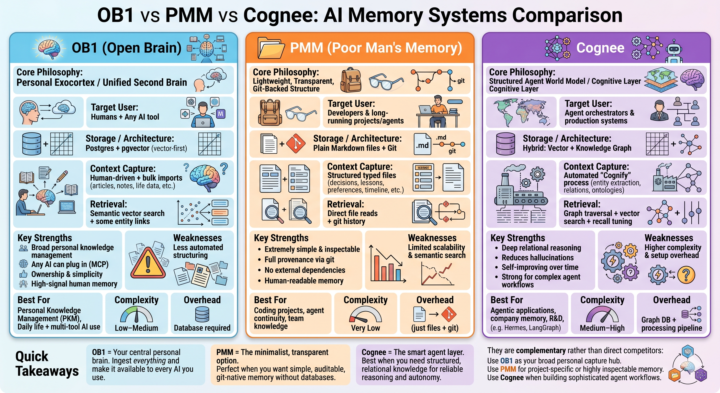
Memory management is the next frontier!
Most people are still treating LLMs like goldfish with infinite context windows. But the real power comes when you give your AI systems persistent, structured, and reliable memory. I’ve been diving deep into three distinct approaches: - Open Brain (OB1) — the personal exocortex - Poor Man’s Memory (PMM) — the ultra-lightweight, git-native path @Millenial Cat - Cognee — the structured graph + vector layer for serious agents Each represents a completely different philosophy for how we should capture, store, and retrieve context. Full breakdown dropping soon: architecture comparisons, strengths & tradeoffs, how they actually fit together in a real stack, and when I’d choose one over the others. If you’re building any kind of long-term AI workflow, personal knowledge system, or agent setup — this one’s for you.What’s your current memory strategy? Drop it below
1 like • 7d
Thank you for sharing this, as the graphic and discussion is exactly what I needed to clearly understand memory systems. Your cross post in another discussion got me here. Between the discussions in both posts the light bulb is flickering more!
2 likes • 7d
@David Vogel thanks! I am finishing up ring two now so I can start on ring three!
10d •
High Tea discussion results in a Win
In yesterday's high tea, we discussed using a Claude skill MD FIle in another AI so that the agent can perform that skill itself, which it otherwise cannot do. In my case, I have a legal AI (not naming it to protect the identity of the guilty) that doesn't allow for much customization to get tasks done; everything is baked into its harness, or at least that is how it used to be. It recently allowed for matter folders to be created. So I had a crazy Idea, what if I took a skill i use in Claude for legal work and pull the MD Files and resources and create a specific skill/instruction folder to house these files and subfolders and use them in this Legal Ai. I gave it a shot and, in the chat, asked it to review the Skill/Instructions first and then take the other matter documents and execute the instruction file to create a specific analysis and document for an asset purchase I am working on for a client. For the first time, this AI analyzed the matter files and drafted a specific type of document that was almost the perfect format I wanted, with minimal editing. This one test has now opened the floodgates on what I can do to improve the outputs of this legal AI platform. I never even thought of trying this until yesterday's discussion over high tea. That one little gold nugget was a big win for me because it makes decent legal ai something more. Thanks @Jake Van Clief
3 likes • 10d
@Dino Behler it took a tool that had some functional limits and made it perform outside of its normal parameters: I am working on some other experiments to see what else I can do with my legal ai Frankenstein!
0 likes • 8d
@Gina Wang it took a good legal ai and made it much better. Never dawned on me that I could try this. Now I am playing with setting up folders differently within the system to try and leverage how content is used and improve the quality of the outputs

9d •
Dumbest in the Room... (Lyceum Update #002)
Hey everyone, first update since my intro. In that post I said learning and building can quietly become a substitute for selling. 12 days later, I'm the proof. Here are my benchmarks as of today: 0 sales conversations with buyers, 0 paid clients, and 64 days until my deadline for a signed, paid client. That's on me. One thing I've taken from @Jake Van Clief is to ask yourself the hardest, most detailed questions you can about your own business and build toward the answers. When I do that, the hardest ones aren't about building. I built a pipeline dashboard on top of Karbon for an accounting firm with Claude Code. The hardest question I currently have is one a prospect could ask me on the first call: "Why you? What experience do you have that shows you can do what you claim?" Right behind it: "What is this costing me right now, in dollars?" I can't answer either one well yet, and until I can, getting people on a call and actually selling to them is going to stay hard. What I'm doing about it this week: sending my first 3 personalized Looms to small accounting firms that has the sole objective of getting a reply. No selling in the video. 3 this week to small accounting firms, then more once I see what lands. Fuck it, I'm not going to learn anything if I don't do anything about it. I'll post how it goes, even if nobody replies. What I'm asking for: if you've had real sales conversations for an AI consultancy or AI implementation business, I want to learn from you. I'm putting together a small peer-to-peer group that meets once a week. Everyone brings what they did that week, what they learned, and one thing they're stuck on, and we hold each other to it. Especially looking for people a step or two ahead of me, but same stage is fine too, as long as it's the same kind of business. Comment or DM me with what your business sells, who it sells to, and how many sales conversations you've had so far. Thanks. Khalil, of Norvain

2 likes • 9d
Not in Lyceum, but I felt compelled to comment. First, you cannot be this hard on yourself; negative thoughts create negative results. You are with a great group and an incredible teacher. Have faith in yourself and believe in the future you want to create. Manifest positive results starting right now! Questions you cannot answer now will not be ones you can't answer in the near future. You know the questions that concern you, now go out and own them, you got this!
1-10 of 67

@matthew-mazur-5170
I am a AI Novice. My other job is as an attorney. I am looking to build my skill set in AI to develop new businesses & improve my existing business.
Active 16h ago
Joined Jun 25, 2026
Florida
Powered by