Activity
Mon
Wed
Fri
Sun
Nov
Dec
Jan
Feb
Mar
Apr
May
Jun
Jul
Aug
Sep
Oct
What is this?
Less
More
Redirect K9s
99
Free
The Detection Dog Lab
947
5.0
Free
3 contributions to Redirect K9s
21d •
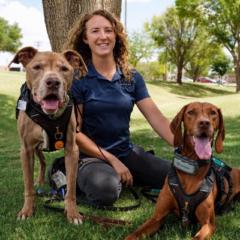
Everyone Needs Help. Even Professionals.
I wanted to talk today about something that some people might struggle with and that is asking for help. Perhaps you have been doing this for a number of years, you are on your second, third or fourth dog, you have been part of a team for a while, copious amounts of operations and attend plenty of workshops in person and online. With dedication like that it can sometimes feel like you finally are starting to have a grip on this whole dog handling thing. Then it happens…either you have a new dog that makes you feel like you don’t know anything or your current dog shows a behavior that you have never seen them do. This is when it is important to reach out to a trusted person that you feel is the best fit not only for your concern but also this dog’s learning style. Preferably a trainer that can adapt to the dog in front of them over one that has the approach of “your dog is this breed so you must do this” or “your dog is this discipline so it has to do that”. Running into snags isn’t just for handlers but trainers too. It is through the difficult moments that learning occurs even for us humans. If we want our dogs to enjoy their work and be successful we figure out how to communicate that to them in the best way possible and tailor training to what that dog needs. Do they need steps broken down into smaller ones? Do they need a different direction? Do they need a whole different approach? These questions, and those like them, are why there are so many different ways to train a dog for the same job and it is important to keep an open mind while also having discernment. You may go to a workshop or seminar and hear something that you think is not helpful but a year or two down the line you remember it and it is exactly what you needed to troubleshoot. I had a similar experience recently and, while I cannot go into detail, I can say that it is a benefit to work with people who have many more years of experience than you. Not just quantity of years but quality and variety. Dog training has evolved tenfold in the past 20 years or so with what is accepted as mainstream. Welfare is huge compared to how it use to be and the types of dogs that have access to work has multiplied in ways that very few probably saw coming.

1 like • 2d
So true, love your comment re asking for help. Hard to do sometimes.
Feb 17 •
Teaching a Reliable Emergency Recall Around Distractions
Recall: a command to cue your dog to return to you. There are various levels to a recall - Kissing noises/happy clapping - typically while squatting to dogs’ level - Patting the couch or bed - Saying their name (this can be said in various tones) - Change of direction - Emergency recall I personally have 3 intentional recalls for my dogs which all have their own cue and meaning. - “come on” means come to my general area (for this I am facing the dog and they are in front of me. I sometimes take a few steps backwards to further cue what I want since this is the weakest one with my dogs.) - “this way” means I am changing direction/going the opposite of you and now I want you to change direction to my new one - “here!” and/or 6 blasts on a whistle means come to my person right away with no hesitation You know you have a good recall when your dog listens to you, and quickly, no matter what is going on. The question is how can you get such a reliable recall - particularly an emergency recall - even in high distractions. First you must find out what your dog absolutely loves more than anything whether it is food or a toy. You can do this via reward selection (which you can find in Imprint Your Detection Dog In 15 Days by @Paul Bunker and in video form on his Skool The Detection Dog Lab) which is typically done with toys but can also be done with food. **It is important to think about doing a reward selection every few months, especially with puppies, since preferences may change over time** Once you have found what your dog loves the most but before you take your dog out for a walk on a long line (doesn’t have to be too long to start) decide what you are going to use as your emergency recall cue! It is important to not jump around from cue to cue to cue trying to figure out what works. Anything will work for your dog as long as they find it productive, reliable and rewarding. Your emergency cue can be “bonsai”, “turtle”, “fireplace”, “tire”, “remote” literally anything.
1 like • Feb 18
Love it, I have had, at times, also had to use the 'dramatic collapse of near death', in my training 😆.
0 likes • Feb 19
@Christina Brewster 😆
Jan 15 •
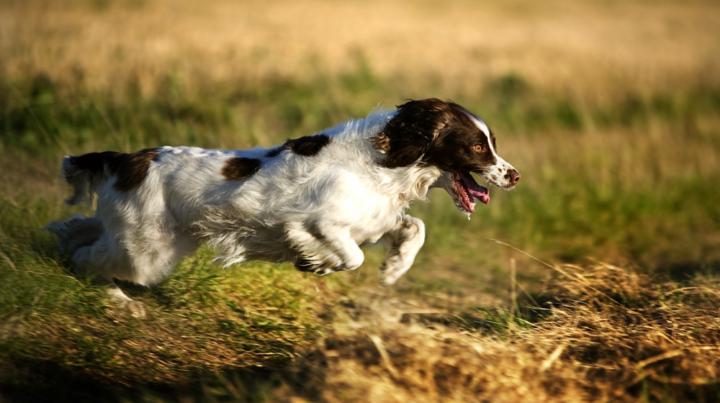
English Springer Spaniel
A Hurricane in a Teacup One of the earliest mention of spaniels in England was in 1576 by English physician John Caius in his book Treatise of Englishe Dogs. In his book spaniels were described and separated by function then later in 1801 Sydenham Edwards suggested that they be divided into Springing, Hawking Spaniel, or Starter; and the Cocking or Cocker Spaniel. The English Springer, alongside other spaniels, primarily grew in the counties of Norfolk and Shropshire. They were originally separated by size: less than 25lbs would be a cocker spaniel and those over 25lbs would be called springers. During this time both types of spaniels were born in the same litters, and both had a function: to serve as a hunting dog. The smaller spaniels, cockers, were used to hunt woodcock, hence the breed’s name, and the larger spaniels, springers, would “spring” or flush the gamebirds into the air. In the 1600s these spaniels were further categorized as land spaniels and were used to not only flush out birds but also rabbits. In 1902 the English Springer Spaniel was officially recognized by the English Kennel Club and recognized by the American Kennel Club in 1910. In 1914 the first English Field Champion was crowned, FTC Rivington Sam, and is considered one of the foundation sires for modern field lines. The Springers job back then is similar to what the field line is bred for in modern day: bird hunting and retrieve game. Whether the hunters used nets, bows, birds of prey or rifles to hunt down the flushed birds the Springer Spaniel remained very important and became known as a gun dog. . Sources: https://en.wikipedia.org/wiki/English_Springer_Spaniel, https://moderndogmagazine.com/articles/breeds/the-english-springer-spaniel/
1 like • Jan 15
100% correct.
1 like • Jan 15
@Christina Brewster ❤️
1-3 of 3
@emma-thompson-3545
Dog handler-K9Aus Capabilities. Business - ETK9 - k9 & handler training. NDTF cert III. Paramedic.
Active 1d ago
Joined Jan 10, 2026