Activity
Mon
Wed
Fri
Sun
Nov
Dec
Jan
Feb
Mar
Apr
May
Jun
Jul
Aug
Sep
Oct
What is this?
Less
More
Owned by Evan
For ministry leaders who still care about their faith but are tired of repeating unhealthy church culture and want community as they navigate change.
54 contributions to The In-Between

Aug 4 •
Stop comparing. Start connecting.
Comparison is hijacking the life you were made for. Your life is meant for meaning — but you'll never see it through a lens of comparison. Do you remember Saul and David? Two men, both called by God — but they used very different lenses to find meaning in their lives. Saul had everything. Chosen, marked for greatness. He even looked the part. But he hid "among the baggage," measuring himself against everyone around him. When the crowd sang David's praises, he couldn't celebrate the victory. All he heard was, "but what about me?" So he tried to control perception and the lives of those around him. It cost Saul everything. When comparison starts to hurt, we don't stop — we turn hostile. We tear the other person down to feel okay again. Comparison robbed him of the very life he was created for. David chose connection instead of comparison. He was called the same way Saul was, but he chose a different frame. Facing the same pressure, his first move was never comparison. It was connection. Even hunted by Saul for years, he honored him and passed on two chances to strike back. When life was uncertain, he found security through connection. Stop comparing. Start connecting. You have unique value, but you'll never offer it as long as you are filtering your life through a lens of comparison.
0
0

Feb 3 •
Coffee Break – Q&A this afternoon ☕️
Hey folks! What's on your mind? What questions do you want to discuss in the next Q&A? Drop them in the comments below and I’ll bring them to the next conversation.
0
0
Jan 29 •
Church Culture Sprint
I’m looking for five churches who want to radically change their staff and team culture in the next 30 days. Every church has a culture—and that culture is shaped by beliefs and behaviors, whether you’ve named them or not. The challenge is this:when you’re inside the culture every day, it’s incredibly hard to see what’s actually shaping it. You need outside perspective and the right tools to identify the beliefs and behaviors that are really driving your culture—both the healthy ones and the harmful ones. Once those are clear, the work becomes rebuilding trust and creating a healthier culture on purpose.That requires knowing which specific beliefs and behaviors actually build trust—and which ones quietly erode it. So, I’m opening up five spots for churches that want to intentionally transform their staff and team culture over the next 30 days. If that’s you, DM me and we’ll schedule a call to talk about reserving a Church Culture Sprint.
0
0
Jan 7 •
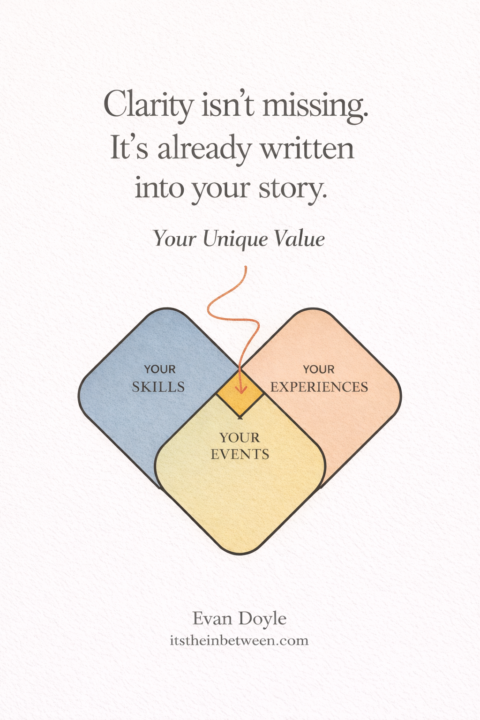
The SEE Triad
What Skills, Experiences, and Events within your life help inform the Unique Value that you offer to this world?
0
0
Jan '24 •
Introduce Yourself! Why did you join The In-Between?
👋🏼 Hey there, I’m Evan. I spent 18 years working at a church, and I’d been part of that same church for over 20 years. I stepped away in 2020. When I decided to step away, what I thought I was walking away from was just the day to day of being a pastor. The rhythms, the title, that kind of thing. Turns out it was a lot more than that, and it took me a while to figure out what. About six months in I started wrestling with things like, who am I if I’m not doing this? What do I actually believe? What do I actually value? I’m also the host of The In-Between podcast, and I wrote a book called Inevitable about loss and transition. Here’s why I put this together. I worked alongside friends in ministry pretty much the whole time I was a pastor, and there were just recurring things we kept running into. I got curious about what was actually underneath it. For me it mostly comes down to trust, and then a layer beneath trust, what we actually value. Not the values on the wall, but what you actually value about how a team works and how people get treated. I don’t have a bullet point list of healthy versus unhealthy. I think it’s more useful to be able to ask where trust is breaking, and whether the conversation you need to have is even possible where you are. So that’s a lot of what we do in here. Three things, really. We get to be human. Our limitations and our questions get to be in the same room as our faith, and that includes looking at our own part in things, not just at the harm that was done to us. We make room to ask questions and think out loud about what might be next, without anybody imposing an answer on you. And we try things. I’m big on running experiments instead of waiting on one giant leap. Throw a few lines in the water, get some data, and use it to make a wiser decision. When I was untangling some of my own beliefs about pastoring, and even my faith, I didn’t want to swing a wrecking ball through my whole life, so I tried to be more surgical about it and look at particular pieces.
0 likes • Jan 4
@Ben Patella Hey there! Thank you for being here! I look forward to connecting! Be sure to mark your calendar for the next live coaching call.
0 likes • Jan 6
@Ben Patella hey there! Yes - you checked the right place! I have the Coffee Break chat's added
1-10 of 54

@evan-doyle-3735
I’m the coach of The Alignment Lab — a 90-day cohort helping faith-driven leaders take their most aligned next step.
Active 59m ago
Joined Jan 20, 2024