Activity
Mon
Wed
Fri
Sun
Oct
Nov
Dec
Jan
Feb
Mar
Apr
May
Jun
Jul
Aug
Sep
What is this?
Less
More
AI Workshop Lite
60.4k members • Free
AI Sales Agency Launchpad
15.6k members • Free
Online Business Friends
112.6k members • Free
The Success Club
16.1k members • Free
Brendan's AI Community
27.2k members • Free
Voice AI Alliance
3.9k members • Free
Voice AI Bootcamp 🎙️🤖
9.2k members • Free
AI Automation Mastery
30.2k members • Free
AI Automations For Business
2.9k members • Free
7 contributions to Voice AI Alliance

Aug 18 •
Quick question for people building AI voice agents
I’m currently working on an AI receptionist for HVAC companies (handling inbound calls + booking jobs). One issue I’m thinking about: 👉 How are you handling real-time interruptions during tool execution? Example: - Caller is speaking - AI is collecting details (name, issue, time) - Suddenly caller changes request or adds emergency info - Or interrupts mid-flow Right now I’m seeing cases where: - The conversation flow breaks - Or the tool gets triggered too early before full context is captured Curious how others are solving this: - Do you rely more on strict state management? - Or dynamic LLM re-evaluation after each turn? - Or interrupt handling at the voice layer (not model)? Would love to hear how you’re structuring this in production systems.
0 likes • 22d
@Raj Baruah This is exactly the issue I’ve been seeing too — especially with booking flows in HVAC where urgency can change mid-sentence. I like your separation idea (conversation handling vs execution). Quick follow-up question: When you say “wait for required fields + confirmation,” do you enforce that through a strict state schema (slot-filling style), or are you letting the LLM decide readiness dynamically each turn? Right now I’m testing a hybrid approach: - LLM keeps re-evaluating intent after every user turn - but tool execution is blocked until a “final intent lock” (basically a confidence + completeness check) The tricky part I’m still solving: 👉 handling emergency interrupts after partial booking info is already collected without losing context or duplicating steps Curious how you avoid that race condition in production.
1 like • 21d
@Raj Baruah That makes a lot of sense, especially the idea of separating “LLM judgment” from “actual execution permission.” The versioning + idempotency key approach is interesting — I haven’t seen it implemented cleanly in voice flows yet, but it feels like the right way to prevent those race conditions. Quick question: When you increment the state version on emergency detection, do you completely discard the previous booking flow context, or do you keep it as a fallback in case the emergency turns out to be misclassified? Also curious how you handle the UX side of that — like how you communicate the switch to the caller without making it feel like the system “reset” mid-conversation. The stale-tool-result issue you mentioned is exactly what I’ve been running into in edge cases, so this helps a lot.
28d •
Feedback wanted: AI receptionist for small HVAC shops — follow-ups, CRM, prompt structure
Building AI voice receptionist for HVAC (2-10 tech shops) — want builder input Building a 24/7 voice receptionist for small HVAC shops (owner-operator, 2-10 techs). Job: answer every call, book directly to calendar, route emergencies correctly, stay in lane on pricing/diagnosis. Currently on Retell AI + Cal.com, no CRM layer. Four things I want real experience on, not theory: 1. Feature list beyond booking — what's non-negotiable that I'm not thinking of? Reminder calls/texts before appointment? No-show follow-up? Anything you built that turned out to be the actual differentiator once live with a real client? 2. Follow-ups — is anyone running reminder/no-show sequences natively off Retell + Cal.com, or does that always require bolting on something else? At what point did you need it — client 1, or later? 3. Single Prompt vs Conversational Flow — for straightforward booking flows (not complex support), has anyone actually run both and compared? Where does Single Prompt start breaking down in practice, and at what call complexity? 4. CRM — running lean with just the calendar right now. What actually breaks without a CRM layer, and at what client count did you need one? What's the minimum viable setup people add first? Real numbers/experience over theory appreciated.
0 likes • 28d
Quick context: running Retell AI (Single Prompt) + Cal.com, no CRM yet. Built around a test HVAC client to work out the flow — call comes in, gets answered, books to calendar, routes safety-critical stuff correctly, stays off pricing/diagnosis. Have a working demo, test calls running clean. Want to hear from people who've taken this live — what held up, what broke, what you added later that you didn't expect to need.
0 likes • 22d
@Rc Hall his is super helpful — especially the latency + interruption testing part. That’s exactly where most “clean demos” start breaking in real calls. A few things I’m curious about from your setup: 1. When you say keeping everything under ~2s latency made the biggest difference — was that mainly model response time, or tool execution delays (calendar/SMS calls)? 2. On your modular setup (Pipecat + n8n): do you ever run into context mismatch between the live voice state and the background workflow state, or does webhook-based separation fully prevent that? 3. Interesting point on interrupt testing — I’ve noticed the same. Caller changes intent mid-flow (especially emergencies), and flow recovery becomes the real problem, not booking itself. In your case, do you reset the conversation state on interruption, or re-merge new intent into the existing context? Really solid breakdown overall — the modular + guardrail split makes a lot of sense for production stability.

Aug 17 •
New paradigm: Voice + web : voice agentic UX
Hi, my name is Muhammad Ibrahim Jaffar and I have been in the voice AI space since before vapi existed. I was building my own voice AI at that time. Since then I have always been at the cutting edge of development. I haven't just used pipecat or livekit. I have hosted open source models on bare metal to get cost as low as 1 to 2 cents a minute with imperceptible latency. I have been trying to innovate in this space and bring something cool and exciting. Today I want to introduce you to a new frontier: Voice agentic UX Its when websites come alive controlled by an agent and the user interacts with the website using his voice (or text). The paradigm is supposed to bring about novel and curated audio visual experiences to market for the future of web. Where website does things for you and all you have to do is ask like you would a person and it holds your hands and guides you through it. Here is an early tech demo example for a car dealership: https://www.loom.com/share/ec77d88f685f4b399d9009ffeb35107f We are at the cusp of a new market and you are the only ones who have the chance to get ahead. Really excited what you think about this.
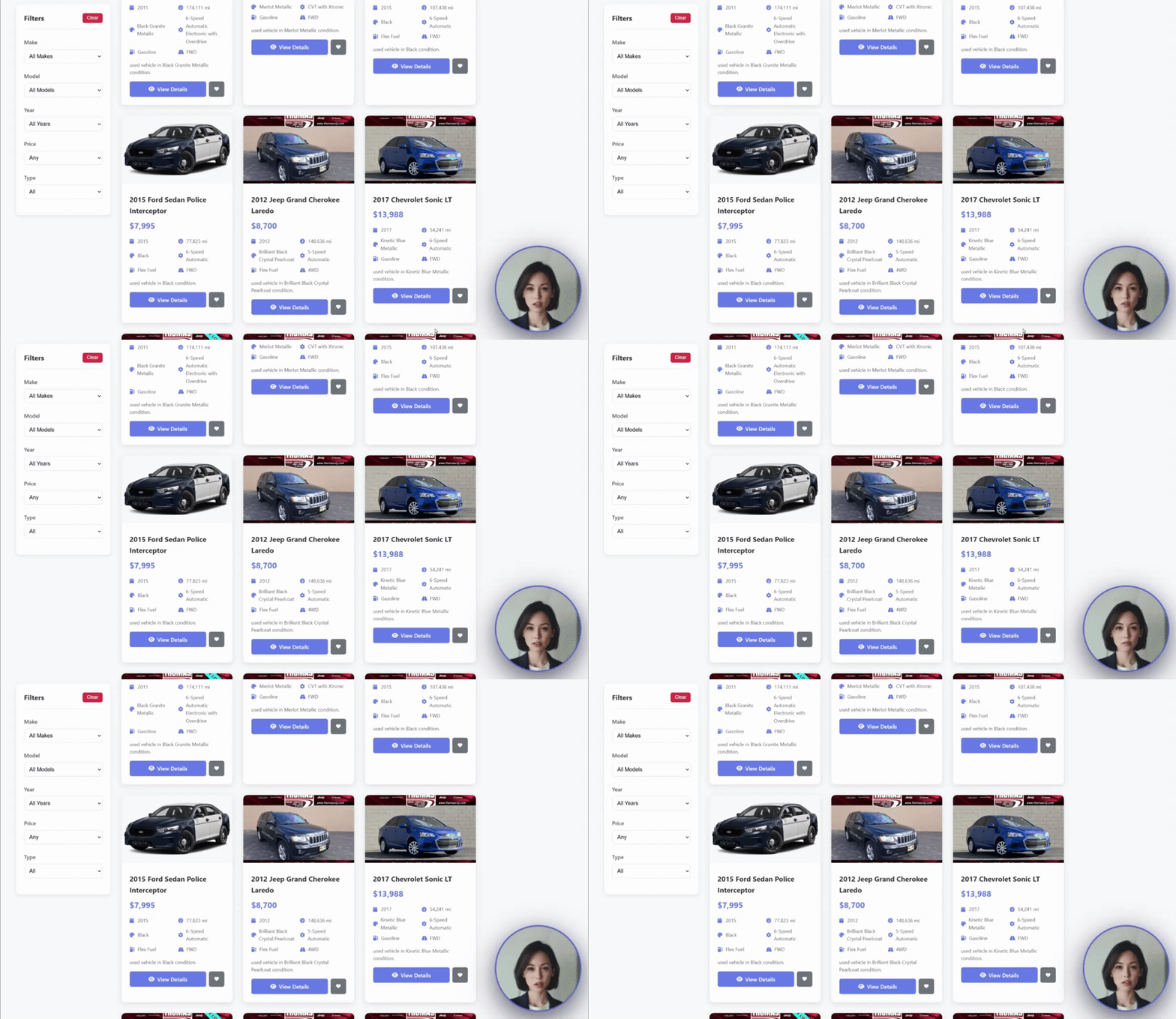
1 like • Aug 19
@Abraham Jafar This is interesting — it feels like the real shift is from “chatting with an AI” → “AI operating the interface for you.” What stood out is the UX angle. If the agent can actually control the website flow (not just answer questions), then onboarding, product discovery, and support all change completely. Big challenge I see is reliability + guardrails — once the agent starts taking actions on UI, small errors can break trust fast. But direction-wise, this feels like where things are heading: less clicking, more intent-driven interaction. Curious how you’re handling state + recovery when the agent makes a wrong step in the UI flow.
0 likes • 30d
@Abraham Jafar That makes sense — showing the correction in the demo is actually a smart move. It builds trust because it proves the system doesn’t need to be perfect, just recoverable. One thing I’m thinking about is intent clarity vs execution speed. If the agent is both understanding intent and controlling the UI, there’s a trade-off: → move fast = risk wrong actions → slow down = better accuracy but worse UX In service businesses (like HVAC), even small friction drops conversions fast, so reliability becomes everything. Curious — are you leaning more toward: 1. letting the agent take action immediately 2. 3. or 4. adding confirmation steps before important actions? Feels like that balance will define how usable this becomes in real-world scenarios.

Aug 7 •
Technical Founder Struggling With Sales – What Would You Do?
Hey everyone, I could really use some advice from people who have actually built and scaled AI agencies. My partner and I recently started an AI automation agency in India focused on real estate. We're both strong on the technical side and build custom AI systems ourselves. Our main offers are: - A WhatsApp AI agent that qualifies leads, answers property queries, recommends properties, and books site visits. - A complete AI agentic system with Voice AI for follow-ups, appointment scheduling, customer support, and other automations. We've tried a lot of local outreach, especially door-to-door visits, but the results have been disappointing. Most SMEs here either don't understand the value of AI yet or expect everything to be extremely cheap. I even tried lowering my price to just $50 for some offers, but that still didn't generate much interest. From what I know about international markets, these same solutions can easily sell for $1,000+ when positioned correctly. The good news is we aren't starting from zero: - We signed a large real estate client who's currently on a one-month free trial. - We're also in discussions with a quick-commerce company (through a referral) for a WhatsApp AI customer support system worth around $500 if the deal closes. The challenge is that I don't think staying focused only on the local market is the right long-term move. I want to start getting international clients. The problem is: - We have no budget for paid ads right now. - Door-to-door obviously isn't possible internationally. - I'm much stronger at building AI systems than I am at sales calls, and I'm not very confident on cold calls in English. - I do have experience with digital marketing, especially Meta ads, but that's not an option without a budget. So my question is: If you were starting from scratch today with solid technical skills but no ad budget, how would you land your first 5-10 international AI automation clients? Would you focus on cold email, LinkedIn, X, Loom videos, Upwork, partnerships, communities, content, or something else?
1 like • Aug 10
You’re actually much closer than you think — the problem isn’t your tech, it’s your market + positioning. From what you described, the issue is local pricing pressure + low awareness. Selling $1,000+ AI solutions in a market that expects $50 will always be a struggle. If I were in your position, I’d do this: 1. Pick ONE clear problem (not “AI automation”) → e.g. missed calls, slow lead response, unqualified leads 2. Target markets where that problem already costs money (US, UK, etc.) 3. Use simple outreach instead of ads: • Cold email with a question (not a pitch) • Short Loom showing THEIR problem + solution • Offer a 5–7 day test instead of selling upfront You already proved demand with your current clients — now it’s just about taking the same solution to a market that can actually pay. Out of curiosity — what specific problem are you leading with right now when you reach out?
1 like • Aug 10
@Kunj Patel Yeah, email definitely works — but not the way most people do it. The reason you see people sending thousands is because they’re doing generic outreach. Low relevance = low replies. If you keep it simple and targeted, you don’t need volume. Even 30–50 highly relevant emails can get replies. What’s worked better for me (and others I’ve seen): • Very specific targeting (same niche, same problem) • Short email with one question (no pitch) • Then a quick Loom showing their exact gap Example angle: “How are you currently handling leads that come in after hours?” That usually gets more replies than a long pitch about AI. You’re already targeting the right problems — now it’s just about making the message feel specific to them, not like mass outreach. Are you personalizing each email right now or sending more general ones?

Aug 8 •
Warm Lead
I have a warm roofing prospect asking detailed questions about WhatsApp automation. I don't have the technical implementation ready yet. I'm looking for someone who can build/deliver this with me. I'll handle sales and the client relationship. You handle the technical implementation. We split the revenue.
1 like • Aug 10
This is exactly the kind of use case I’ve been building around. I’ve already got a working AI receptionist for home service businesses (handling calls + booking), so extending this into WhatsApp follow-up/automation for roofing is very doable. Curious — what specifically is the client asking for right now? Lead qualification, follow-ups, or full booking flow? Happy to jump in and build this with you if it aligns.
0 likes • Aug 10
@Dawood Faisal Just sent you an email 👍
1-7 of 7

@fatima-kb-8798
Building AI voice agents that help service businesses capture missed calls and book more jobs.
Active 21d ago
Joined Dec 2, 2025
Powered by