Activity
Mon
Wed
Fri
Sun
Oct
Nov
Dec
Jan
Feb
Mar
Apr
May
Jun
Jul
Aug
Sep
What is this?
Less
More
Allistar Center
188 members • Free
23 contributions to Allistar Center

7d •
Missed you all for a bit — here's what's new.
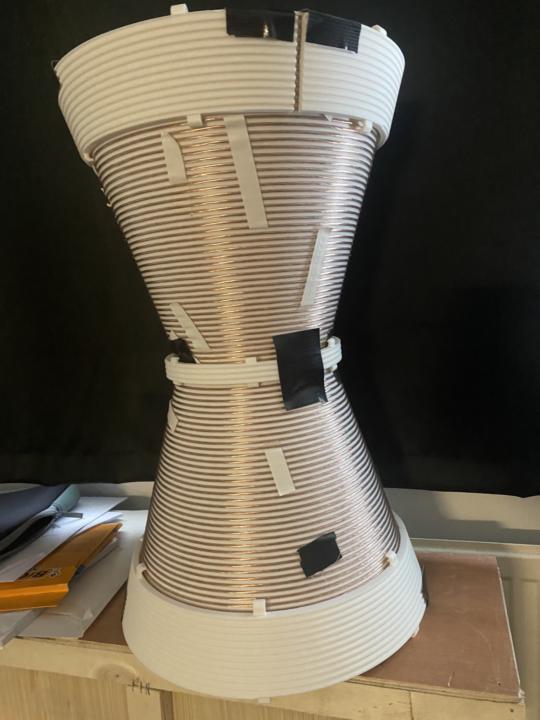
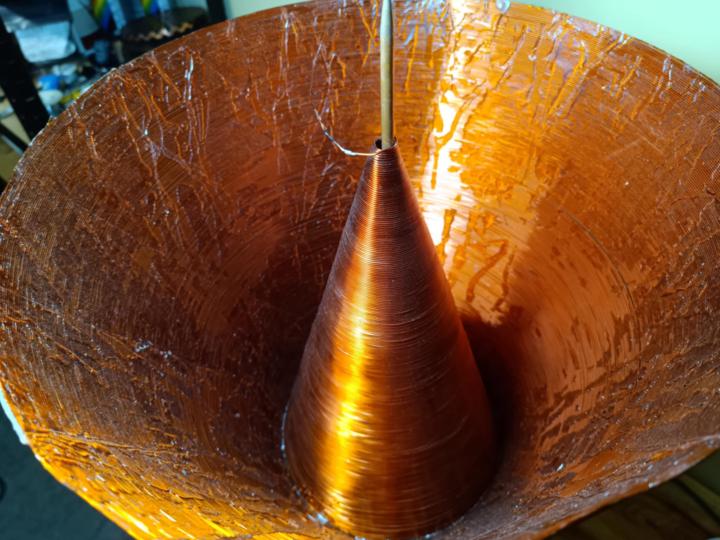
Been heads-down in the lab for weeks instead of posting — long overdue for an update. Here's part of what's happened since I went quiet, more to come. Claude helped me calibrate and connect one of my VNAs to the PC software and run some tests. The cones showed an amazing S11 (Return Loss) at a resonant frequency of 2.85 MHz. Later, when using a Slayer circuit with a MOSFET, the LED got brighter at that same frequency — which independently confirmed the measurement. S11 tells you how much power sent into the antenna is actually absorbed versus reflected back to the source. You can see the numbers in the first image, and in the second image you can get a sense of what a value like -61 dB actually means in practice. The third image shows the Sierpinski gasket Merkabah. You can see multiple spikes with good S11, but they sit well above what a standard oscilloscope or signal generator can handle — most of that gear only works up to 80–90 MHz, so it's essentially blind above that range. I also need to rule out contamination from the leads sticking up off the coax cable, since they can act as a dipole antenna themselves and might be contributing to some of those spikes. Next, you can see I'm building crystal holders where I wind copper wire and arrange them symmetrically around the cone's equator, pulsing them that way. This isn't the final design yet. Working in Fusion 360 hasn't been easy for me, but I just discovered something amazing — using an MCP connection, I can actually talk to Claude Code, and it executes the parametric modeling for me, examines what I've already built, and suggests better designs and ideas. This could take things to a whole new level and finally help us build the structural elements for the big Space-Time Antenna — the parts that need to hold real weight and hold tight tolerances. The last few days I also learned something important about diodes. The ones I've been using aren't good above about 30 kHz. A diode doesn't switch off instantly when voltage reverses — it keeps conducting backward for a short window first. On the scope, that showed up as roughly 450 nanoseconds of "leakage" every cycle. At low frequency that's nothing, but at 1 MHz each full cycle is only 1000 nanoseconds long, so that dead zone eats up nearly half of it. And yet we were still getting some power transfer above 800 kHz despite that.


1 like • 7d
glad your ok, I was thinking that your gravity system worked and you could be floating in space or something. :-)
1 like • 20d
well I do hope he is Ok, I have not heard from him in a while
2 likes • Jun 21
Terrific workmanship Arttu - thats a classy looking STA
Apr 2 •
Scaling the STA to crystalize and amplify the entire electromagnetic Field of the Planet
This is longer audio excerpt from the secon or third private session with Bashar. He give the general measurments and confirm that this is exactly what Nicola Tesla was thinking to do with the Wardenclyffe Tower. (notice hist intonation while he is doing that). The Wardenclyffe Tower is 57 meters tall and Bashar explained that 10-11 meters are actuall enough. In the last sessions he said N.Tesla now know from spirit that the initial scale he invision can bu much smaller.
1 like • Apr 2
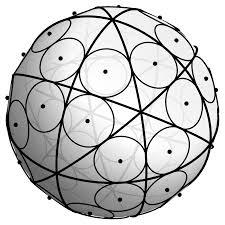
thanks K, vortex's - the building block of all that is
Mar 24 •
Claude with skill as research Assitant is doing great job
Here is a PDF with my interaction with Claude AI which is programed with skill to be as Research assitant. Inside the PDF you can see my blury, random noise question first, just wrote what came first. Then ask Grok to gleam the grammar mistakes and structure it as Buletpoint with clean structure and feed this as question to Claude. Then you see what the response is. Im sharing this because Im fascinated by the clarity and reasoning with this AI model, and Im sure that will help us tremendously to move the project further. It understood the Manual perfectly and brake down the loginc in clear and organized structure. Its jus very useful. Also, will add the images that Was uploded to with the first question. It really helps to understand the creative process of energy from many new perspectives.
1 like • Mar 30
IF quartz were to be able to lower the etherical energy to a usable energy - it would be positioned over the center copper spike, near the cone tip OR near the center where the two cones intersect? How large a quartz crystal?
1 like • Mar 30
the electric field is highly concentrated inside the cone tips, and it is known that quartz is highly effected by electric fields.
1-10 of 23