Activity
Mon
Wed
Fri
Sun
Nov
Dec
Jan
Feb
Mar
Apr
May
Jun
Jul
Aug
Sep
Oct
What is this?
Less
More
Owned by Jim
Understand living systems through permaculture principles, regenerative farming, safe medicinal herb use, and calm practical family resilience.
Understand bees as living systems through observation, biology, evidence, and thoughtful stewardship of colonies, landscapes, and community.
Faith & Flowers
16
Free
575 contributions to Oasis Builders
9d •
Buying things that last and saving the planet
We live in a time when you can buy a cheap Chinese chainsaw for the price of two cans of fuel , decimate a forest and then throw it in the bin. At the same time eco activists are being give custodial sentences for super gluing themselves to bulldozers and throwing paint at works of art . When are we going to grow up? Rather than the energy ratings we see on new products, they should be embodied energy and durability ratings, with a estimate of how long a item is expected to full fill it's function without repair, with an ease of repair assessment. For example an electric car being a zero and a pedal bicycle being a 10.
🔥
0 likes • 6d
@Sarah Peterson An important skill to be able to work with your hands.
🔥
1 like • 23h
@Phillip Greenwood @Sarah Peterson It made me think of a saying here in TN. They equate a happy marriage to how many barns one has. To keep peace on the farm, the men spent a lot of time in the barn so if he has two barns, he must be extra happy :-)
🔥
24h •
Could Someone Else Use Your Household Records?
Last week, we looked at how household records can reveal patterns we might otherwise overlook. A shopping list, collection of receipts, or maintenance history can help us recognize what happens repeatedly. But there is another question worth asking. If someone else in our household needed that information, could they find it, understand it, and know what to do with it? Many of us have our own ways of keeping track of things. We know where the appliance manuals are stored, which notebook contains maintenance information, or where we keep the list of household supplies. These arrangements may work perfectly well for us because we created them. But what happens when someone else needs that information? Perhaps another family member needs to find the replacement filter information for an appliance. Maybe someone is preparing the grocery list while the person who normally handles the shopping is unavailable. Even a simple record can become frustrating when its location or meaning is known to only one person. A useful household record should answer three questions: 1. Where can I find it? The information needs a location that an appropriate household member can identify. 2. Can I understand it? Labels, dates, and notes should make sense without someone having to explain every entry. 3. What can I do with it? The information should help someone recognize what has been done, what is needed, or where to find further instructions. This does not mean everyone needs access to every household document. Financial, medical, and other sensitive records deserve appropriate privacy and protection. Nor does it mean creating elaborate filing systems or more paperwork. Often, the improvement is something small like a clearer label, a shared location for an ordinary supply list, or a note that explains what an entry means. This Week's Small Step Choose one ordinary household record that someone else might reasonably need to use. It could be a shopping list, supply inventory, appliance information sheet, or maintenance note. Ask an appropriate household member to locate it and explain what the information tells them, without first showing them where it is or explaining how it works. Notice whether they have difficulty finding it, understanding an entry, or knowing what the information is useful for. Then make one small improvement, if needed.
Poll
3 members have voted
🔥
0 likes • 23h
Sad but also somewhat comical. When my mother-in-law passed away unexpectantly, my father-in-law could not cash his own paycheck. Mother-in-law had opened the bank account signing his name as well as every other aspect in his life and household. When she passed, he had no clue about their finances or anything else in the house. The kids came to his rescue, taking him to the bank where he had to prove his identity and change the signature card. Over a month or so, my wife went through her filing system and was able to figure his life out for him. To save money, she even canceled her life insurance keeping insurance on him without him even knowing. Possibly the world today is a bit different with everything digital although communication within the family is so important in so many ways.

🔥
8d •
Flea Infestation
This is the first time I've had a flea Infestation. Our family rescued kittens 2 months ago and somehow they're covered in fleas. We used dawn dish soap to carefully clean them a few times. My guess is when I let them outside a few times to visit with their mother she infected them. So we are implementing a long term plan to get them down on the property and out of the house. Curious if any of you have used Ecomask Spray with beneficial nematodes that contains the species Steinernema carpocapsae? To eradicate from soil.

🔥
1 like • 4d
@Sarah Lauren vet says safe and not to mistake Ai for his vet degree when I questioned it :-) My underrstanding is a time release chemical like capstar.
🔥
0 likes • 1d
@Sara Abrams my girl the same… she is about 15 years old and not had an issue… old gal still goes out every night I guess to mouse but not sure she still has it in her; she has not brought us one home in several years.
🔥
2d •
What Do We Know, and How Do We Know It?
When we prepare a meal, we often draw on knowledge gathered from different places. We might remember how our grandmother prepared beans, notice how vegetables change as they cook, follow advice from an experienced cook, or read research about food and nutrition. Each can teach us something, but they do not necessarily tell us the same kind of thing. A family tradition may help us understand how a food was prepared and shared across generations. An experienced cook may recognize when a dough needs more moisture. Our own observations may help us understand what we enjoy and what works in our kitchen. Scientific research asks different questions. It uses systematic methods to investigate patterns, relationships, and possible causes. Even then, the conclusions depend on what was studied, observations and how the research was conducted. Sometimes we have an idea that seems reasonable but has not been adequately tested. That is a working hypothesis, something worth investigating rather than treating as established fact. We do not need to dismiss personal experience or traditional knowledge simply because it is not scientific research. But we should understand what each can reasonably tell us. One small practice this week is to think about something you believe or regularly do when preparing food. Ask yourself where that knowledge came from. Was it something you experienced, learned from another person, inherited through tradition, or found in research? Then consider what you actually know and what you might still need to learn. What is one cooking or food practice you learned from someone else that has stayed with you, and what has your own experience taught you about it? When you decide how to prepare a familiar food, what do you rely on most?
Poll
2 members have voted
🔥
1 like • 2d
@Phillip Greenwood Exactly, food doesn't just nourish us in the moment, it can reconnect us with people, places, seasons, and experiences from our past. I think that's a big part of where the idea of comfort food comes from. Certain flavors and aromas bring back memories we haven't thought about in years. It's interesting how something as ordinary as food can keep those connections alive throughout our lives.
🔥
3d •
Why the Compost Community Changes
Last time, we explored how different members of the compost community perform different jobs. But what causes some organisms to become more active while others become less active as decomposition continues? The answer begins with the changing conditions inside the pile. Think about a pile made from fresh grass clippings, fallen leaves, and chopped garden plants. As microorganisms consume the more easily decomposed compounds for food and energy, the pile begins to change, leaving behind materials that generally take longer to break down. The pile may settle, moisture and airflow can change, and biological activity may generate warmth. Each change influences which organisms can thrive and how actively they work. This is one way to understand ecological succession in compost. As the available food and habitat change, the balance of biological activity changes with them. But succession is not a fixed schedule where bacteria finish their work, fungi take over, and worms arrive at the end. Bacteria and fungi can remain active together, while other organisms graze, shred, consume, and mix materials wherever conditions suit them. Even within the same pile, a moist center, a drier outer layer, and a pocket of woody material can support different patterns of biological activity. Consider two compost piles started on the same day. One is large and warms considerably. The other is a smaller, slower-decomposing leaf pile. Both support decomposition, but their communities may respond differently because their food, moisture, oxygen, structure, and temperature conditions differ. The compost community changes because the environment and available food change. Ecological succession is a shifting relationship, not a universal timetable. This week's observation is to look at two different areas of a compost pile, leaf pile, or mulch layer. How do they differ in moisture, texture, warmth, or material breakdown? What might those differences tell you about the conditions supporting life there?
Poll
5 members have voted
🔥
2 likes • 2d
@Sarah Lauren Exactly
🔥
3 likes • 2d
@Robert Chan Great question! Knowing when compost is ready to use comes down to observing its condition and understanding how it was made. I look for compost that has cooled and remains near the surrounding air temperature, has a pleasant earthy smell, and has broken down into a darker, relatively uniform material. Some woody fibers may remain because they naturally take longer to decompose. These are good signs of stability, but they do not guarantee safety. What went into the pile matters much more. Manure, animal remains, and other potentially contaminated materials require additional precautions. Proper temperature management and evenly turning the pile can greatly reduce pathogens, but does not guarantee their total elimination. Personally, I primarily compost plant materials. When I use manure, it comes from our deep chicken bedding, which has already undergone some decomposition. I manage my piles through repeated heating and turning cycles. If the process does not develop the heat as intended, I rebuild the pile and continue composting rather than treating the material as finished. Our vegetable kitchen scraps generally go to the worm bins, where another community of decomposers go to work. I keep animal remains out of my garden compost and typically but out in the brush for nature to handle. Compost readiness depends on its ingredients, how it was managed, whether it has stabilized and matured, and how we intend to use it. And compost does not have to resemble fine coffee grounds. Once it is adequately processed and stable, I prefer applying it to the soil surface beneath fresh mulch. Any remaining woody fibers can continue decomposing through the activity of fungi and other soil organisms allowing decomposition to continue while supporting the living soil.
1-10 of 575
🔥
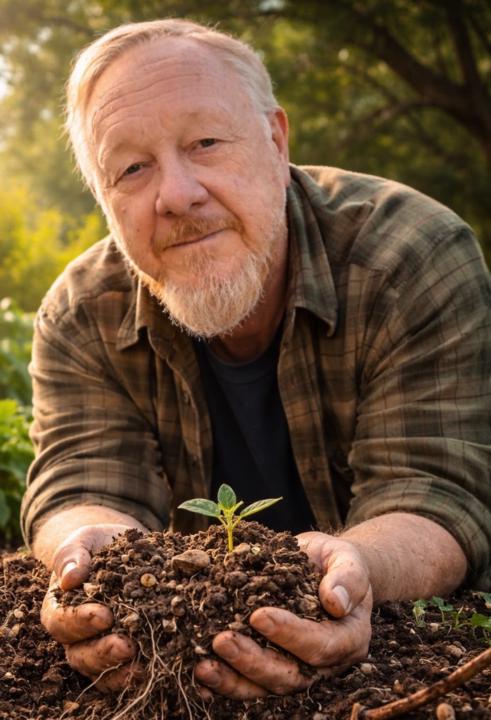
@james-flach-4044
I help families understand off grid living, grow real food, use herbs wisely, and build a more self-reliant home without fear or overwhelm.
0
Reply
Active 12h ago
Joined Dec 22, 2025
ENTP
Cookeville, TN 38506