Activity
Mon
Wed
Fri
Sun
Oct
Nov
Dec
Jan
Feb
Mar
Apr
May
Jun
Jul
Aug
What is this?
Less
More
The iSurgeon iCircle
58 members • Free
2 contributions to The iSurgeon iCircle

7d •
When the numbers don’t match the expectations… Refractive surprise after cataract surgery
By Dr Kashmira Rawjee Modern cataract surgery is refractive surgery. A refractive surprise refers to an unexpected residual refractive error after cataract surgery, where the achieved postoperative refraction differs from the planned target. Although uncommon with modern biometry and IOL calculation formulas, refractive surprises can still occur and may significantly impact patient satisfaction. Fortunately, when surprises occur, we have excellent solutions available. The main types of refractive surprise after cataract surgery are classified according to the residual refractive error, it can be myopic, hyperopia or parent as residual astigmatism. A refractive surprise may result from: • Unusual ocular anatomy (short or long eyes) • Prior corneal refractive surgery • Ocular surface disease affecting keratometry • Errors in biometry or lens selection • Effective lens position variability • Less commonly, postoperative IOL displacement In this weeks case, this patient experienced an unexpected hyperopic refractive surprise following routine cataract surgery with a visual acuity of 0.7. Although the surgery itself was uncomplicated, the postoperative refraction left the patient dissatisfied with their visual outcome. Rather than performing an intraocular lens exchange—which can be technically more challenging and carries additional risks once capsular fibrosis has developed—I elected to implant a supplementary (add-on) intraocular lens in the ciliary sulcus. What is an add-on IOL? A supplementary IOL is specifically designed to sit safely in the ciliary sulcus, in front of the original capsular bag IOL. It works by adding the required refractive power to correct the residual error while leaving the primary lens undisturbed. Advantages include: Precise correction of residual refractive error Preservation of the original capsular bag IOL Lower risk than late IOL exchange Reversible if future intervention is required Excellent visual outcomes in appropriately selected patients


0 likes • 7d
Yes, these patients often present with poor uncorrected vision which is below their expectations ,despite a quiet, healthy-looking eye. A careful refraction is key, as residual astigmatism or an unexpected spherical outcome may be the main issue, and many cases are very manageable once identified. Most patients prefer specs rather secondary procedures.
Jan 14 •
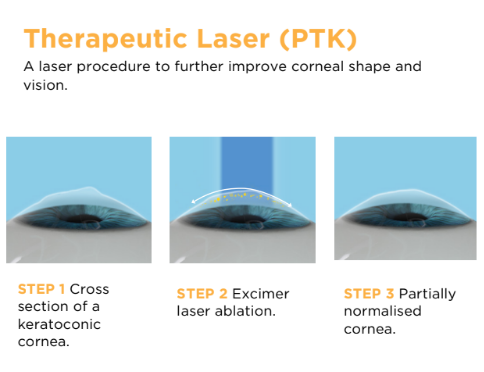
Therapeutic laser in keratoconus to improve quality of vision.
By Dr Sachin Bawa Cross linking often stops progression of keratoconus, however does not improve refractive outcomes. PTK (phototherapeutic keratectomy) uses the same excimer laser used in LASIK and PRK. This laser can be combined with cross-linking in keratoconus patients with a suitable cornea to improve the topography and optics. PTK can be performed at the time of cross-linking to reduce corneal surface irregularities. PTK helps reduce higher-order aberrations and can lead to improved corneal topography and enhanced quality of vision. Suitable patients are those with a pachymetry greater than 450um and lower levels of irregular astigmatism. PTK can also be performed after cross-linking. Below is a case study of patient: History: 21 year old lady with keratoconus progression. We planned to perform a PTK of 50um to reduce the irregularity over the cone. The amount of microns is determined by the epithelial map which allows us to precisely remove a specific depth of epithelium and irregular stroma. Based on this epi map we have decided to go with 50um to remove the epithelium. This was followed by a standard cross-linking. Traditionally in crosslinking we use alcohol to remove the epithelium. Post operative: One can note that the axial map is improved showing reduced K readings. The refraction and visual acuity have also improved: Refraction: Pre Op L) -4.00/-6.00X141 Post Op L) -4.50/-4.75X145 Visual Acuity: Pre Op VAL) 0.6 Post Op VAL) 0.7 Patients undergoing crosslinking combined with PTK will often have good best corrected visual acuity with spectacles and improved quality of vision
0 likes • Mar 4
Very informative !! if Contact lens are to be used , how long would you wait to fit post operatively
1-2 of 2