Activity
Mon
Wed
Fri
Sun
Oct
Nov
Dec
Jan
Feb
Mar
Apr
May
Jun
Jul
Aug
Sep
What is this?
Less
More
4 contributions to KRISTINA’S PEPTIDE JUNKIES 24

Feb 25 •
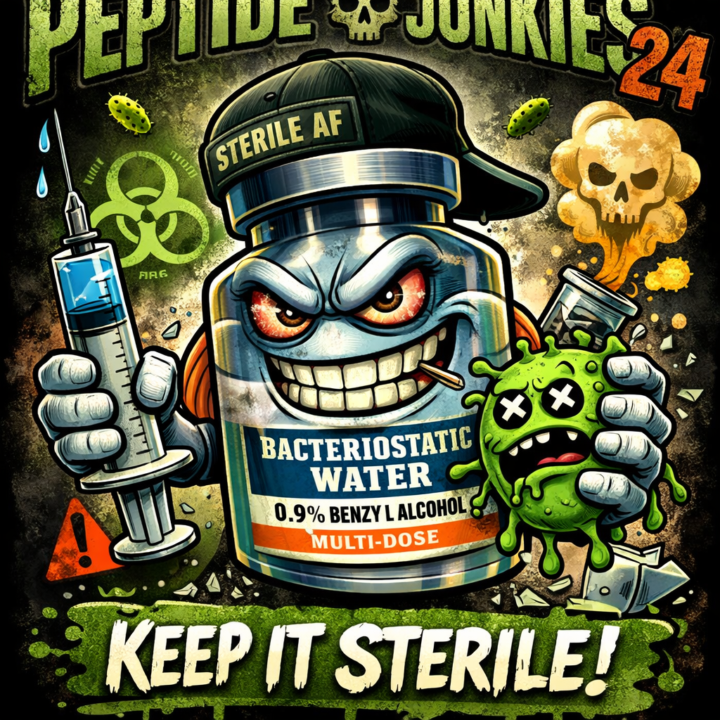
Bacteriostatic Water- The Most Overlooked Variable in Your Peptide Stack: What It Is, Why Source Matters, and Risks of Counterfeit Product
If you’re running peptides but ignoring your reconstitution quality, you’re missing one of the biggest risk variables in your entire protocol. Everyone obsesses over: - Source of peptides - Dosing - Stacks - Storage But almost no one talks about the water. Let’s fix that. 1. What Is Bacteriostatic Water? Bacteriostatic water is sterile water for injection that contains a small amount (0.9%) of benzyl alcohol as a preservative. The benzyl alcohol inhibits the growth of most bacteria, which allows the vial to be used multiple times (multi-dose) when handled properly. That benzyl alcohol: - Inhibits bacterial growth - Allows multi-dose vial use - Extends safety after first puncture - It’s not “just sterile water.” It’s a preserved injectable solution manufactured under pharmaceutical-grade sterile conditions. Used correctly, it protects your peptide solution. Used incorrectly — or sourced poorly — it can wreck your entire protocol. Key Characteristics: - Sterile (manufactured under strict pharmaceutical standards) - Contains 0.9% benzyl alcohol - Intended for reconstitution of medications or peptides - Typically supplied in multi-dose vials - Used within 28 days after first puncture (per standard pharmaceutical guidance) It is commonly used to reconstitute peptide powders such as GLP-1 analogs, growth hormone–related peptides, and other lyophilized compounds. 2. Why It Must Be Purchased from a Reputable Source: If your bacteriostatic water is counterfeit or improperly manufactured, you risk: - Microbial contamination - Endotoxin exposure - Incorrect benzyl alcohol concentration - Improper pH - Non-sterile production - Injectable products must be manufactured under: - Cleanroom conditions - USP standards (United States Pharmacopeia) - cGMP compliance (current Good Manufacturing Practices) - It must contain the correct concentration of benzyl alcohol - It must be properly filtered, sterilized, and sealed

3 likes • Feb 25
It is a "guide". You can still use it effectively past 28 days. The refrigerator is dark when doors are closed, so it will be fine.
Feb 11 •
SILK PEPTIDES: WHAT ARE THEY AND WHY DO I NEED THEM IN MY LIFE?
AVAILABLE IN MY SHOPIFY STORE!!!! https://peptidejunkies24.shop 10% off your first order of $50 or more with code: KRISTINAMARIE
0 likes • Feb 11
Is there a peptide that is called 'silk peptide'? If so, where is it?
0 likes • Feb 11
@Kristina Marie yes, I did read about it and also checked your website. It sounds interesting. Thank You.

Feb 6 •
Reta
I have been on 15mg Reta with 1.5 bac water since July. I have lost 80lbs so far. Do you continue taking Reta or maintenance and how much unit. I understand more clearly on unit. Lol. Thanks for helping me
0 likes • Feb 10
You can use a peptide calculator to adjust your units as you titrate down to find your maintenance dosage = not losing weight nor gaining weight. If you want to get off Reta entirely, you then continue to titrate down to the lowest dose you started with using the same dosing schedule where you titrated up to 15mg.

Jan 3 •
Reta Microdosing
I am currently on Reta 3mg and losing but I have noticed I am always nauseous. I was going to try microdosing and see if it stops. What does microdosing Reta look like?
0 likes • Feb 10
To mitigate any GI issues when using Reta, pin BPC-157 at least 1 hr before pinning Reta. Of course, different for everyone. This has resolved the reta GI issues for many, including myself.
1-4 of 4
@latrice-s-6915
Awesome individual, all about factual information and being responsive.
Active 7h ago
Joined Dec 30, 2025
Powered by