Activity
Mon
Wed
Fri
Sun
Nov
Dec
Jan
Feb
Mar
Apr
May
Jun
Jul
Aug
Sep
Oct
What is this?
Less
More
Brotherhood Of Scent
9k
5.0
Free
Watch Lover | Community
2.7k
5.0
Free
Real Men Real Style Community
13.6k
5.0
Free
2291 contributions to Brotherhood Of Scent

Feb 8 •
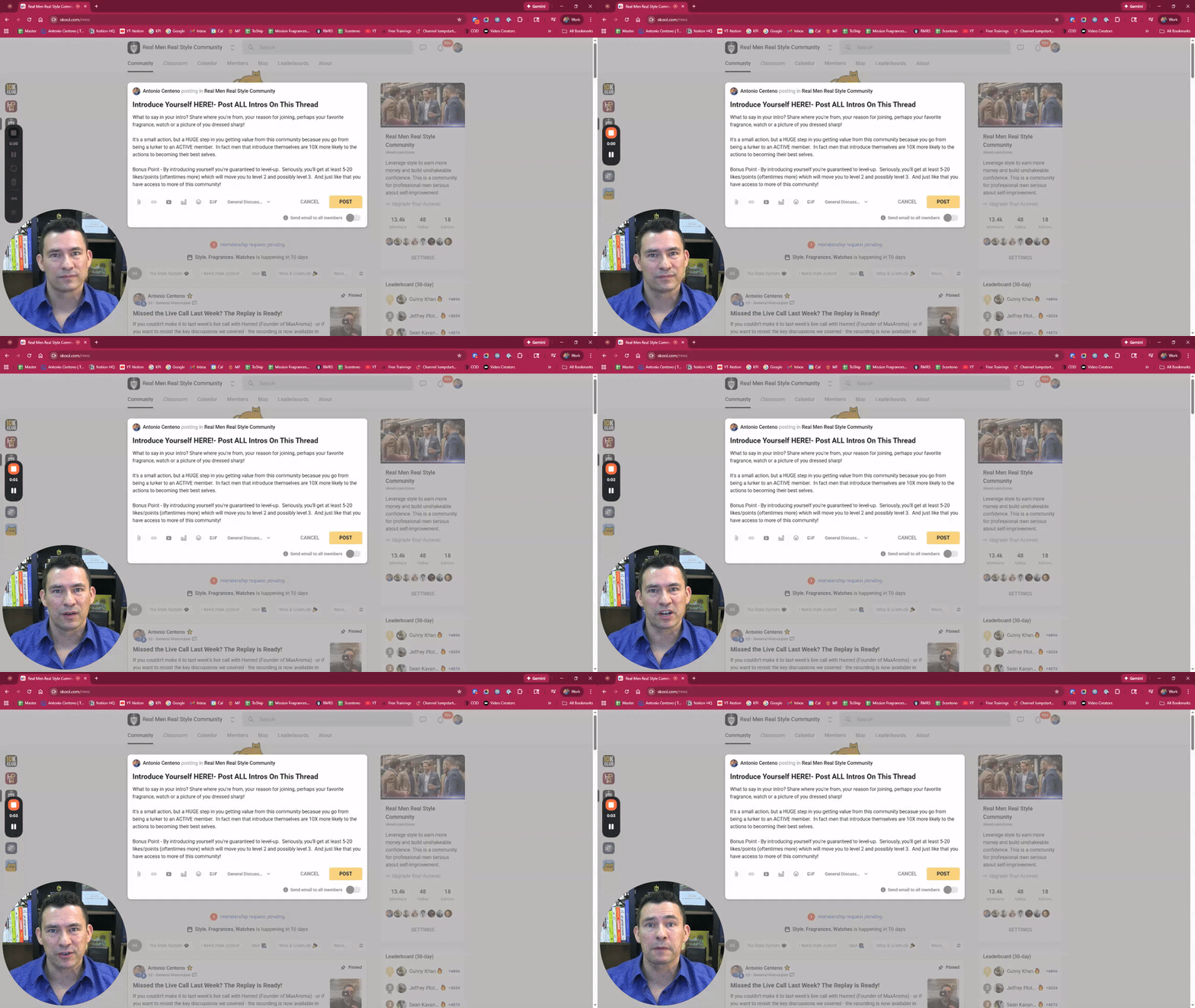
Introduce Yourself HERE!- Post ALL Intros On This Thread
What to say in your intro? Share where you're from, your reason for joining, perhaps your favorite fragrance, watch or a picture of you dressed sharp! It's a small action, but a HUGE step in you getting value from this community becasue you go from being a lurker to an ACTIVE member. In fact men that introduce themselves are 10X more likely to the actions to becoming their best selves. Bonus Point - By introducing yourself you're guaranteed to level-up. Seriously, you'll get at least 5-20 likes/points (oftentimes more) which will move you to level 2 and possibly level 3. And just like that you have access to more of this community!

🔥
7 likes • 6d
@Darius Hollman welcome to the community!
🔥
2 likes • 5h
@Christopher Barkman welcome to the community!
🔥
1d •
A little Allure Sport Eau Extreme for the road
I’m on my way out of town on a last minute work trip and I thought I’d grace my fellow passengers with some Chanel Allure Sport Eau Extreme. It’s been a minute since I’ve worn this and I was really missing it today, so that’s what I went with before heading out to the airport. One and a half sprays to each arm and four light sprays around my neck. I absolutely love its mix of citrus, mint, vanilla, musk, light aromatics, and creamy woods. It’s a few hours until my flight so it should die down by the time I board. But part of me is hoping it won’t - everyone on the plane should enjoy the delight that is this banger. Every. Single. Person.

🔥
4 likes • 23h
@Ben E nice! Superleggera has a musk note that I find grating but Eau Extreme is one of my first, and favorite, bottles. Eight hours later, and I’m still catching whiffs of it.
🔥
1d •
New release JPG Fleur de Male - woof, not for me
So I thought I’d spin the wheel and try out the new re-release of JPG Fleur de Male. Woof, it is absolutely not for me. And I think… it’s not going to be for everyone. What I can say is it is very well balanced, relatively complex with a lot going on that all work together, but is just wholly unappealing to me. I’m not the biggest fan of florals (I’ve tested Le Beau Narcisse and Flower Edition and reacted pretty negatively to those) but was wondering if I’d like this one based on the interesting note breakdown. The florals in this don’t work for me the same way they don’t work for me in Le Beau Narcisse - something about the orange blossom has an edge that doesn’t sit well with me, it’s less smooth and less crowd pleasing than say what you find in YSL Myslf. But on top of that, there’s some really weird stuff going on in this new release - a fair amount of bright powdery green, with a hint of pine that I do like, but a dusty earthy undertone (maybe from the hay or tobacco note?) that to me really takes this in an unappealing direction. In the air it’s not terrible - but up close it’s not appealing to smell which is a must have for me (if I’m not sniffing my arms like a monkey all day, it’s not a keeper…). There’s kind of a retro feel about it as well, in a nod to the OG I think this will appeal to fans of the OG and maybe people who tolerate florals or more interesting : challenging designer compositions - but unfortunately this one is not for me. Anyone here tried the new one or love the OG?

🔥
1 like • 1d
@Stephen DeMent hmm if you like Narcisse you might like this one… or it might make you mad. Hard to tell

🔥
2d •
Daily Fragrance Hacks and Tips: Fragrance Testing 10/05/2026
10. Test on skin, but use cotton rounds too: For me, skin is still the best way to really understand a fragrance. A paper tester in a store is fine for getting a quick first impression, especially of the opening, but it doesn’t tell me the whole story. You really need skin to see how the fragrance develops on you, how it projects, and what happens once it gets into the heart and drydown. That said, I also like using unscented hypoallergenic cotton rounds as a secondary testing method. I keep them at home, and they’re easy enough to carry with me when I’m going somewhere to test fragrances. https://www.amazon.com/dp/B07VSBRRHD?ref=ppx_yo2ov_dt_b_fed_asin_title&th=1 https://www.amazon.com/dp/B09542G9ZN/ref=vp_d_pb_cml_lp_B07VSBRRHD_pd?_encoding=UTF8&pf_rd_p=9c76da3e-1986-461f-80fe-90d97a5b2d1f&pf_rd_r=VFRVSXM184KT7GR79F81&pd_rd_wg=xHrmI&pd_rd_i=B09542G9ZN&pd_rd_w=CSpTa&content-id=amzn1.sym.9c76da3e-1986-461f-80fe-90d97a5b2d1f&pd_rd_r=91c00bd7-5e69-4f58-b999-cebba9366fb9&th=1 What I like about cotton rounds is that they hold the fragrance well and give me something I can come back to later. I can spray one, put it aside, and smell it again an hour, three hours, or even several hours later. That gives me a much better idea of how the fragrance changes over time instead of judging everything from the opening. Another thing I do is place the sprayed cotton round in a small plastic food-storage zip bag. That lets me take it home, keep different fragrances separate, and revisit them later when I want to study the drydown or get a sense of how much scent is still hanging around. I wouldn’t treat that as a perfect real-world longevity test, because sealing it in a bag slows normal evaporation, but it’s a great way to preserve the sample and compare how different fragrances evolve over time.

🔥
4 likes • 1d
@Mike Penzenik I’ve used the cotton rounds and find they hold the fragrance a bit better than paper strip. Maybe it’s that they have more surface area with all the fluffy fibers, and when I stick my nose all up into it, I get a deeper sense vs if it were paper. Not as good as skin, but even at my most insane I can’t really test more than 6 frags on skin at once but I can definitely do far more rounds in one testing session

🔥
2d •
SOTD – Bvlgari Man in Black
Today's SOTD is my first-ever sampling of Bvlgari Man in Black. I've frequently seen this described as a bold, intense fragrance, so I was expecting something that would come roaring out of the atomizer. Surprisingly, it seems considerably more subdued on my skin. But the opening is very nice. Tobacco, rum, and spices create a warm, boozy introduction, with leather, tonka bean, and guaiac wood underneath adding some sweetness and depth. It's rich without being overwhelming, and certainly feels like a fragrance designed for cooler weather. The real question is what happens from here. Since this is my first wearing, I want to pay particular attention to how it develops through the drydown—and then give it several more full wears before making any decisions about a bottle. It also has the misfortune of arriving only a couple of days after I revisited Parfums de Marly Herod. As a tobacco fragrance, Man in Black isn't playing in Herod's league for me—at least not yet. Herod's tobacco immediately grabbed my attention, while the vanilla and spices blended beautifully around it. Man in Black is pleasant so far, but it hasn't produced that same reaction. Still, that's why I bought samples instead of bottles. Current status: Interesting first impression. Keep testing, especially through the drydown—but Herod remains comfortably ahead in the tobacco-fragrance race.

🔥
4 likes • 2d
I’ve tried both the EDP and the Parfum — the EDP has some iris in it which isn’t for me, but the Parfum is on a short list for a full bottle for me…
🔥
2 likes • 1d
@Robert Sheard yeah I’d say try a sample of the Parfum
1-10 of 2,291

🔥
@nick-clemente-7446
On a personal growth journey - losing weight, getting stronger and upping my style game. Building a consulting practice for tech and finance companies
Active 5h ago
Joined Jan 29, 2025
INTP
Powered by