Activity
Mon
Wed
Fri
Sun
Nov
Dec
Jan
Feb
Mar
Apr
May
Jun
Jul
Aug
Sep
Oct
What is this?
Less
More
Owned by Nick
Build, run, and sell managed AI agents for your business or for clients. A free community founded by Nick Vasilescu.
49 contributions to Agent Empire

19h •
The Demo to Delivery Drop-Off
Getting an agent to complete a workflow on your own machine feels like magic the first time it works. But taking that working test script and actually packaging it into a reliable service a client can use daily is where things get messy. You go from debugging logic to chasing edge cases, handling output checks, and trying to keep client communications organized. For those building managed agents here, where does the real friction start once the core workflow actually runs?

0 likes • 3h
Yep this is the gap. A demo that runs on your laptop isn't the product. Friction starts when the run has to keep working when you are not watching: edge cases, checking the output, and what the client hears when something breaks. nice work naming it and on receipt vs follow-up: if the run can close itself with evidence, it stays a receipt. If a human has to approve, decide, or supply missing input, it becomes a follow-up. https://docs.orgo.ai/guides/hermes

19h •
Help me Nick ! !
Hey @Nick Vasilescu I've a question for you , the question is that : 1. what's the best way to get my first client cold calling or cold email ? Give a solution pls I'm suffering to get client . What should I do to get my ever client ? please help me bro .
0 likes • 3h
hey mahin, thanks for asking this straight cold call vs cold email is the wrong first fork. steal the offer first: one clear AI employee you can sell to a small business, then pick whichever channel you can actually stick to for ~20 real conversations. this is the playbook (also pinned here): https://www.youtube.com/watch?v=fAhwYrjmQRk
5d •
What will your agent finish tonight? New episode with Karsten Stinis
The new Agent Operators episode with Karsten Stinis is live. Karsten installs managed AI agents for businesses in Belgium. His offer is €2,750 for the setup, then €250 a month for support. The part I'd pay attention to is what happens during the installation: he watches the client work, finds a recurring task, and aims to have something useful waiting for them the next morning. Before you install the agent, decide what it will finish. A morning briefing is a good example: meetings, open tasks, and unanswered emails worth following up on. The person can open it, check the sources, and decide whether it helps. Whether you're building for yourself or a client, try scoping one overnight job: 1. The job: choose one recurring task. 2. The inputs: name the inbox, calendar, or task list it needs. Connect the accounts and check access. 3. The result: decide where the output should appear and when it should be ready. Make it easy to trace back to its sources. 4. The review: choose who checks it. Keep outgoing messages as drafts for the first run, and have a person approve them. Run it once. Read the output with the person who will use it. Use their corrections to improve the next run before adding another job. In the episode, Karsten walks through Hermes on Orgo, Composio for connecting business tools, Honcho for memory, and how he monitors usage and incidents. Keeping the workflow working is part of the service. He also reports one client's agent setup being built in 22 minutes. Humans still handle the tool and account connections. Watch the full conversation: How He Sells AI Agents for €2,750 + Monthly Support https://www.youtube.com/watch?v=Y8MJG3iDtSo What would you want your agent to have ready tomorrow morning? Share the job below.
0 likes • 4d
@Sean Gannon appreciate it sean glad the videos (esp karsten) are useful, more coming
1 like • 1d
appreciate it mahin glad these are cutting through the noise for u. more coming

5d •
If you vibe code client projects, this is the backend problem nobody talks about.
The front end is easy. Lovable, Claude, Cursor — done in hours. But the moment a client needs real pricing logic, business rules, or calculations — you're either hard-coding it into prompts or writing custom backend code. Both are a nightmare to maintain when something changes. I built a solution. Here's how it works: → You vibe code the front end (any tool) → It connects to n8n → n8n pulls the business logic from Quotix (the engine I built) → Quote calculated, result returned to the front end → Lead pushed to GoHighLevel automatically No black box. No hard-coded prices. Full control over the business logic from one place. https://www.loom.com/share/256a189b6ba74aa2bf53aeab14569bc0 I'm looking for people to test this. If you build for solar, HVAC, roofing, electrical — or any service business that needs on-site quoting — drop a comment or DM me. Free to test.
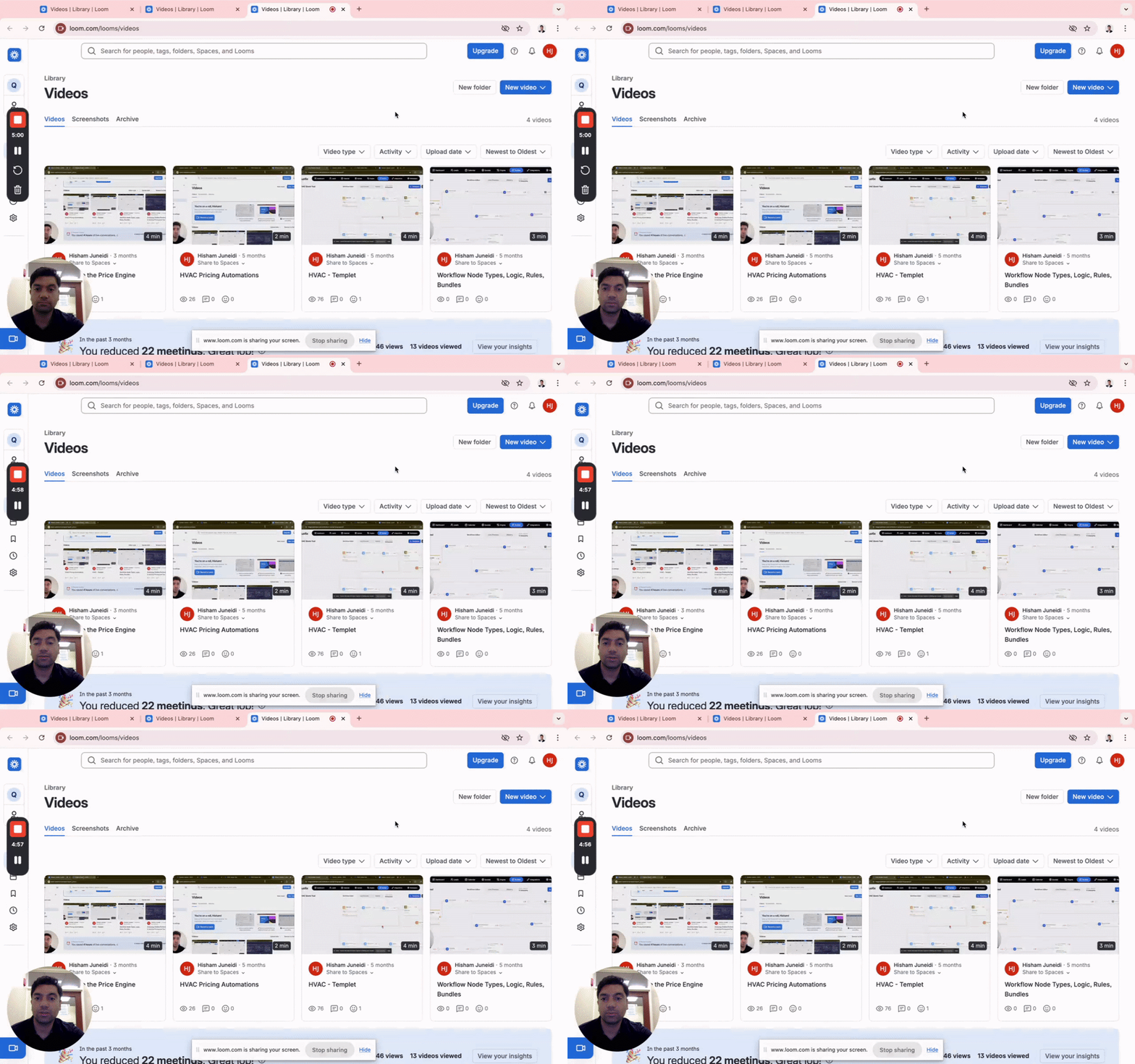
1 like • 4d
@Hisham Juneidi appreciate the ask hisham on the orgo side we put business logic on the agent computer, not only in chat and not only in the workflow graph. hermes skills + tools, files, and an ICM-style home a fresh agent can open: what it can do, what ran last, what still needs you. that durable home is the product; the computer is where it lives. https://docs.orgo.ai/guides/hermes
0 likes • 4d
appreciate the ask hisham orgo is the computer the agent lives on. with hermes, skills + tools + state in ~/.hermes/ stay on that box across sessions, not just in the chat or the n8n graph https://docs.orgo.ai/guides/hermes
Jul 2 •
Sell AI Employees to Small Businesses (just steal mine)
I just built a full AI employee from scratch in this video. Everyone’s hyped on agents but barely anyone’s actually showing how to build ones that can really work inside a business. Here’s the entire stack I spun up live (no holding anything back): • Cloud computer running Hermes on Orgo • Its own email (AgentMail) • Its own phone number (AgentPhone + iMessage) • Telegram as the main chat interface • Every tool & connector hooked up through Composio • Credit card so it can actually spend money • Obsidian vault as its knowledge base / second brain • Latitude for observability so I know when shit breaks I made one main orchestrator agent (named it Hubert) that stays in charge 99% of the time and just hands tasks off to specialized sub-agents underneath it. One giant bloated agent is a nightmare to debug. This way everything stays clean and purpose-built. Full live build, every prompt I pasted, every terminal I opened… it’s all in there. And I’m giving away the complete templates for the orchestrator + every sub-agent I build going forward. I'm giving you actual employees that can do real work. Watch the whole thing here: PS - the template is free here on Github: https://github.com/nickvasilescu/nicks-stack
0 likes • 6d
Louis welcome. Orgo (assuming that is what you meant by Ogo). For loading the steal-mine Hermes setup: 1. Watch the full build (this is the one): https://www.youtube.com/watch?v=fAhwYrjmQRk 2. Free template on GitHub: https://github.com/nickvasilescu/nicks-stack 3. In Orgo, create a computer from the Hermes / template path, then wire only what you need from the video (AgentMail, phone, Telegram, Composio, etc.). 4. Product docs for templates and Hermes: https://docs.orgo.ai/guides/templates/introduction https://docs.orgo.ai/guides/hermes If a specific click is unclear, reply with a screenshot and I will point at the next step.
1 like • 5d
Thanks for asking about VM sizing before you stack agents on one box. For Hermes on Orgo, start here from the docs: - Single-user terminal chat: 8 GB RAM, 4 CPU - Skills, browser tools, gateway: 16 GB RAM, 4 CPU - Long-running multi-tool flows: 32 GB+ RAM, keep CPU at the top of your plan (hard cap today is 4 vCPU per computer) Disk: if you omit it, create uses the plan birth size (40 GB on current paid plans). Grow as the agent accumulates skills and artifacts; per-computer disk tops out at your plan ceiling, up to 300 GB hard cap. How many agents on one VM: docs do not publish a fixed count. It depends on workload, especially browser heaviness. Hermes guidance for multi-tenant is one Hermes computer per user, then scale out with more computers rather than packing forever. https://docs.orgo.ai/guides/hermes https://docs.orgo.ai/guides/instance-types https://www.youtube.com/watch?v=fAhwYrjmQRk
1-10 of 49

Online now
Joined Nov 19, 2025
Powered by