Activity
Mon
Wed
Fri
Sun
Sep
Oct
Nov
Dec
Jan
Feb
Mar
Apr
May
Jun
Jul
Aug
What is this?
Less
More
Owned by Stephen B.
A curated menu of courses, content, and tools for creators and solopreneurs; explore, choose what fits, and move forward with clarity.
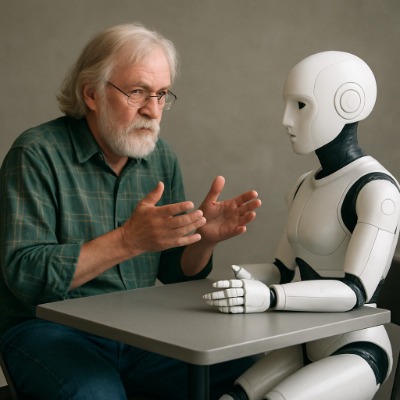
Stephen B. Henry’s "Your Pathway To Growth" community is a calmer, safer place for learning A.I. through natural conversation and guidance.
Skoolers
162.4k members • Free
Tools For Motivation Community
2.7k members • Free
IN SESSION
9 members • Free
Phoenix Rising
20 members • Free
Promotion Hub
88 members • Free
Skool Network 💲💰📈💰💲
163 members • Free
The SKOOL Directory
936 members • Free
the skool CLASSIFIEDS
2.1k members • $7/month
Skool Nexus
228 members • Free
69 contributions to 🔹Digital Boss Skool Hub🔹

🔥
2d •
🎬 The Conversational Age #8
Human Judgment in an Artificial World Every significant technological advance has raised the same question. "If the machine can do this, what is left for people to do?" The Industrial Revolution asked it when machines began performing physical labor more efficiently than human hands. The computer age asked it when software automated calculations that once occupied entire departments. Today, artificial intelligence has revived the question once again. If a machine can write... If it can analyze... If it can summarize... If it can generate ideas... Where does that leave us? It is a reasonable question. It is also the wrong one. The better question is this. What can only people do? That answer begins with judgment. Artificial intelligence can process enormous amounts of information. It can recognize patterns across thousands of documents. It can organize complex material in moments. It can compare alternatives, summarize research, and generate possibilities with astonishing speed. Those are extraordinary capabilities. But capability is not the same as judgment. Judgment asks different questions.Should this idea be pursued? Is this the right decision for these people? What are the long-term consequences? What values should guide this choice? No amount of information can answer those questions completely. They require experience. They require perspective. They require wisdom. Throughout history, knowledge and wisdom have often been confused. Knowledge gathers facts. Wisdom decides what to do with them. Artificial intelligence dramatically increases access to knowledge. That does not automatically produce wisdom. Consider two people standing before the same map. Both possess identical information. One chooses a safe route. The other wanders into danger. The difference was never the map. It was the judgment applied while reading it. Artificial intelligence is much the same. It can provide remarkable maps. People still choose the destination. This distinction becomes increasingly important because A.I. often presents information with confidence. Confidence, however, is not certainty.
2
0

🔥
3d •
🎬 The Conversational Age #7
The New Literacy Every generation inherits a different definition of what it means to be educated. There was a time when simply being able to read set a person apart. Later, writing became an essential skill for business, government, and scholarship. Arithmetic opened the door to commerce, engineering, and science. As the twentieth century progressed, understanding how to use computers became increasingly important. Then came the Internet, where success depended not only upon accessing information but also upon learning how to find it. Each of these developments expanded what society considered basic literacy. Today, another change is quietly unfolding. For the first time in history, millions of people are learning to interact with knowledge through conversation rather than through commands, menus, or search boxes. That is a new literacy. When most people hear the word "literacy," they immediately think of reading and writing. Those skills remain indispensable. Without them, much of modern life becomes extraordinarily difficult. Yet literacy has always been about more than recognizing words on a page. It is about participating fully in the world around us. Reading allows us to absorb ideas. Writing allows us to express them. Conversation allows us to refine them. Artificial intelligence is making that final step more important than ever before. For decades, our relationship with technology was largely instructional. We told computers exactly what to do. Every click had a purpose. Every command produced a predictable result. If we gave poor instructions, the machine failed. That model shaped the way we thought about technology. Conversational A.I. changes the relationship. Instead of navigating software, we engage in dialogue. Instead of memorizing commands, we explain our intentions. Instead of searching for isolated answers, we explore possibilities. The interface has become language itself. That is a profound development. Children growing up today may never know a world in which typing precise keywords into a search engine was considered an advanced skill. Instead, they will expect technology to understand questions, follow conversations, remember context, and help develop ideas. Their literacy will include something previous generations never imagined. The ability to think effectively through conversation with intelligent systems.

🔥
5d •
🎬 The Conversational Age #6
Working Beside Intelligence For generations, we have measured technology by one simple question. "What can it do for me?" The tractor plowed fields. The calculator solved arithmetic. The word processor replaced the typewriter. The spreadsheet automated calculations. Each tool performed a task more quickly or more efficiently than before. Artificial intelligence certainly does those things. It writes. It summarizes. It translates. It organizes. It analyzes. Yet describing A.I. only in terms of the tasks it performs misses the larger transformation that is taking place. The real question is no longer, "What can it do for me?" The more important question has become, "How can we work together?" That single shift changes almost everything. When people first encounter conversational A.I., many approach it like a sophisticated appliance. They ask for a list. They request an outline. They generate a social media post. The work is completed, and the interaction ends. There is nothing wrong with that. Sometimes a simple task deserves a simple solution. But if every interaction follows that pattern, much of the technology's potential remains unexplored. Consider the difference between hiring someone to mow your lawn and bringing someone onto your team. The first person completes a specific assignment. The second contributes ideas, notices opportunities, identifies problems, and helps improve the overall result. One performs a task. The other participates in a process. Conversational A.I. is at its best when it becomes part of the process. Suppose you are developing a new course. You could ask artificial intelligence to generate ten lesson titles. It almost certainly will. Or you could begin a discussion. "What questions is my audience asking that I may have overlooked?" "What objections might prevent someone from enrolling?" "Which lesson should come first, and why?" "What important topic have I forgotten to include?" Suddenly, the interaction changes. Instead of producing content, you are shaping understanding. That distinction matters.

🔥
8d •
🎬 The Conversational Age #5
Your Second Brain Is Here Most of us have experienced the same quiet frustration. A good idea arrives while driving, taking a walk, or lying awake in the middle of the night. It seems obvious, important, and worth remembering. By morning, much of it has disappeared. The idea itself may still be there, but the details, the connections, and the excitement that surrounded it have faded. Our memory has always worked that way. Remarkable, yet imperfect. We remember stories while forgetting names. We recall emotions while overlooking facts. We connect seemingly unrelated experiences, yet sometimes struggle to remember where we left our keys. That is not a flaw. It is simply part of being human. For centuries we have created tools to extend our memory. We carved symbols into stone. We filled notebooks with observations. We built filing cabinets, libraries, databases, and computers. Each step allowed us to preserve more knowledge than our minds alone could comfortably hold. Artificial intelligence represents the next step in that progression. Not because it replaces memory. Because it complements it. This is why I often think of conversational A.I. as something resembling a second brain. The comparison is not perfect, nor should it be taken literally. Your biological brain remains the source of judgment, imagination, experience, empathy, and purpose. Artificial intelligence possesses none of those qualities. What it can do exceptionally well is remember, organize, compare, summarize, and reconnect information that might otherwise remain scattered across countless notes, documents, emails, and conversations. Think about how many unfinished ideas you have accumulated over the years. A notebook with half-developed concepts. A folder of articles you intended to write. Business plans waiting for another look. Course outlines. Research projects. Books you hoped to begin "when there is time." Most people are not short of ideas. They are short of continuity. Ideas become separated by weeks, months, or even years. Connections that once seemed obvious disappear beneath the demands of everyday life.
2
0


🔥
12d •
What if your content could keep bringing you traffic MONTHS after you posted it?
If you’re exhausted trying to constantly feed the social media machine just to stay visible, Pinterest might be worth paying attention to. I’ve been checking out @Rose Berry From AI Side Hustle Academy Community’s Pinterest course and I’m really impressed with what she put together. It’s not just Pinterest training either. She has a Pinterest bot that helps you create your pins AND workflows to help you actually put everything into action without trying to figure it all out yourself. And right now she has the whole thing on sale for $49 through Sunday. For what’s included, I think that’s a REALLY good deal. 👉 Pin 📌 Prompt & Profit Drop Your latest pin 📌 in the comments and lets support each other this weekend! Affiliate disclosure: I earn a commission if you purchase through my link, at no extra cost to you.
Poll
16 members have voted

🔥
2 likes • 12d
"What if your content could keep bringing you traffic MONTHS after you posted it?" Mine does!
1-10 of 69
🔥
@stephen-b-henry-9359
WordPress Wizard & Coach's Coach: instructor, guide, mentor on your journey of success. The time to hire your guide: before you get lost in the woods!
Online now
Joined Apr 19, 2026
Powered by