Activity
Mon
Wed
Fri
Sun
Nov
Dec
Jan
Feb
Mar
Apr
May
Jun
Jul
Aug
Sep
Oct
What is this?
Less
More
Owned by Sterling
This group is designed for the discussion of the Vagus Nerve, techniques to stimulate it, and the benefits of doing so.
Your home for vagus nerve coaching. Get clients, support meaningful results, and have fun building a practice that makes a difference.
32 contributions to DeSci - Decentralized Science

16d •
Why Medical Research Is Broken And How DeSci Fixes It
The standard advice on medical funding assumes the $7.3 billion cancer budget targets our biggest risk. But the biology of aging only receives $400 million. This disparity creates a massive bottleneck in how we address human health. Currently, half of our researchers spend 25% to 50% of their time writing grant applications rather than conducting experiments. When the grant process takes up to 20 months, we lose more than just time. This inefficiency contributes to Eroom’s Law, a trend where drug R&D productivity has halved every nine years since 1950. Think of it like trying to save a city by repairing houses after they catch fire, while ignoring the power grid that causes the sparks. We fund the firefighting of specific diseases but starve the grid maintenance of aging biology. The results are evident in our lack of progress. As of 2023, there are zero approved drugs for reversing human aging, and preclinical reproducibility remains as low as 10% in some sectors. Decentralized Science (DeSci) is breaking this cycle using smart contracts—digital agreements that execute automatically—to create community-governed funding through organizations like VitaDAO. These organizations use transparent, on-chain voting and shorter proposal timelines to move research away from risk-averse gatekeepers and toward a model that values speed and verifiable results. Closing this funding gap is the first step toward moving longevity from a theoretical goal to a reality that changes how we actually age. The rest is worth a read at the link. https://pmc.ncbi.nlm.nih.gov/articles/PMC11317406/
0
0

Aug 27 •
The Real Reason Scientific Innovation Is Starting To Stall
Half of all scientists spend 25% to 50% of their time writing grant applications. This administrative trap is exactly why scientific progress is starting to stall. The current funding model forces researchers into a cycle of risk-aversion. When a standard R01 grant takes up to 20 months to secure, the incentive shifts away from high-stakes discovery and toward incremental work that is guaranteed to pass a conservative peer review. This systemic friction creates a bottleneck where the number of breakthroughs per research dollar is actually declining. If we want to reverse this trend and restore scientific productivity, two shifts must follow. First, we have to decouple funding from bureaucratic gatekeeping. Traditional systems are often poor predictors of actual productivity, leading to preclinical reproducibility rates as low as 10 percent. We need mechanisms that prioritize shorter proposals and faster turnaround to keep researchers at the bench rather than the desk. Second, decentralized science, or DeSci, is emerging as a viable alternative. By using blockchain-based organizations known as DAOs, the community can govern funding through transparent, on-chain voting. This allows for the support of high-risk projects that traditional institutions frequently overlook. Specialized groups like VitaDAO and AthenaDAO are already applying this to fields like longevity and women’s health. These organizations use smart contracts—self-executing digital agreements—to automate execution and democratize access to intellectual property, creating a more agile environment for biotechnology. Moving away from a centralized, paper-heavy system is no longer just a preference; it is a necessity for maintaining the pace of innovation. Reducing the administrative load is the only way to return the focus to the actual science. The full breakdown of these new funding models is worth a look. https://pmc.ncbi.nlm.nih.gov/articles/PMC11317406/

Jul 29 •
How Decentralized Science Is Reversing The Biotech Productivity Collapse
50% fewer drug approvals per billion dollars every nine years. Despite record funding and more scientists, biotech productivity is in a steady freefall. This decline, known as Eroom’s Law, is driven by a systemic shift where administrative burdens consume the majority of scientific effort. Half of all researchers now spend up to fifty percent of their working hours writing grant applications rather than conducting experiments. Traditional funding cycles take nearly two years to process and heavily favor incremental work over breakthrough discoveries. This risk-averse environment results in a preclinical reproducibility rate as low as ten percent, stalling the development of transformative therapies. The stagnation is most visible in longevity science, where zero drugs have been approved to slow human aging despite animal results with compounds like rapamycin. Funding for aging biology remains a fraction of other fields, receiving roughly four hundred million dollars compared to seven billion for cancer. Decentralized Science (DeSci) is emerging as a structural alternative by using blockchain-based Decentralized Autonomous Organizations (DAOs) to bypass these bottlenecks. These groups use smart contracts—self-executing digital agreements—to automate funding and govern research through transparent community voting. Specialized groups like VitaDAO and AthenaDAO are already deploying this model to fund longevity science and women’s health. By shortening proposal timelines and using token-based incentives for peer reviewers, they aim to restore the high-reward nature of biotech. This shift toward on-chain governance and decentralized data storage provides the traceability needed to address the reproducibility crisis. While still in the early stages with thirty-six active DAOs, the model offers a viable path to reverse the productivity collapse. A deeper dive into these funding models is worth a read. https://pmc.ncbi.nlm.nih.gov/articles/PMC11317406/
0
0

Jun 10 •
The Future Of Biotech: How Decentralized Science Is Changing Research
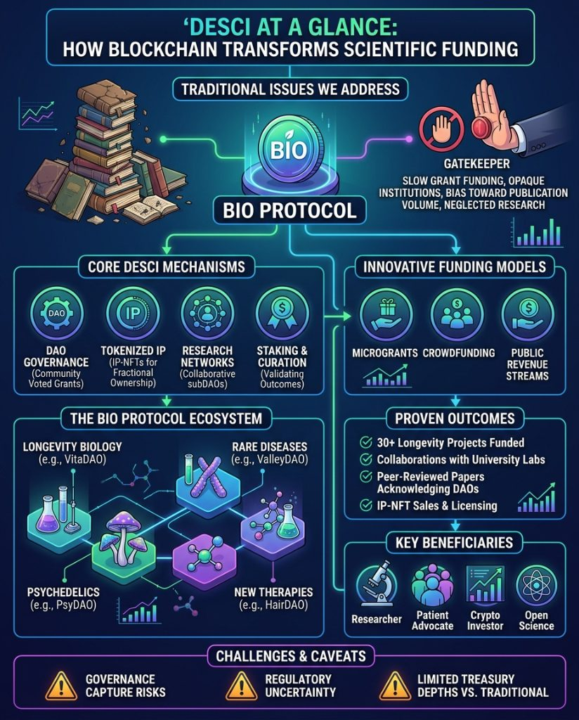
Decentralized science (DeSci) applies blockchain infrastructure, DAOs, tokenization, NFTs, and smart contracts to fund, publish, and govern scientific research outside traditional institutions. It targets structural misalignments in academic rewards for publication volume, pharmaceutical VC focus on near-term returns, and government grant biases, enabling funding for areas like longevity biology, neglected tropical diseases, and low-margin diagnostics. DeSci funding models include DAO-based grant allocation, where token holders vote on proposals from a shared treasury with on-chain transparency; tokenized intellectual property, where IP is represented as NFTs or on-chain licenses granting early funders fractional ownership and future royalties; research NFTs for minting datasets, protocols, or findings as transferable assets for licensing; and staking-based curation, where participants stake tokens on proposals, earning rewards for validated success or facing slashing for failure or retraction. Bio Protocol serves as a coordination layer for biotech subDAOs including VitaDAO (longevity), HairDAO (alopecia), PsyDAO (psychedelics), and CryoDAO (cryopreservation). Each subDAO has its own token and governance but aligns via the BIO token, which enables voting on treasury deployment, subDAO onboarding, resource allocation, and receipt of subDAO token allocations. BIO provides indirect portfolio exposure across research domains. DeSci handles intellectual property through IP-NFT frameworks like Molecule's, where research data and methods are minted as on-chain assets for direct licensing, paired with off-chain legal agreements for enforceability. This ensures on-chain, publicly auditable ownership transparency, contrasting traditional opaque IP licensing. Verified outcomes include VitaDAO funding over 30 longevity projects, collaborations with University of Copenhagen labs, IP-NFT transactions worth several million dollars, and peer-reviewed papers acknowledging VitaDAO; Molecule facilitating rare disease drug development funding, patient-researcher connections, and IP marketplace volume; LabDAO building token-accessible open laboratory infrastructure for wet lab and computational resources.
0
0
May 25 •
From Speculation To Architecture: The Future Of Institutional Blockchain
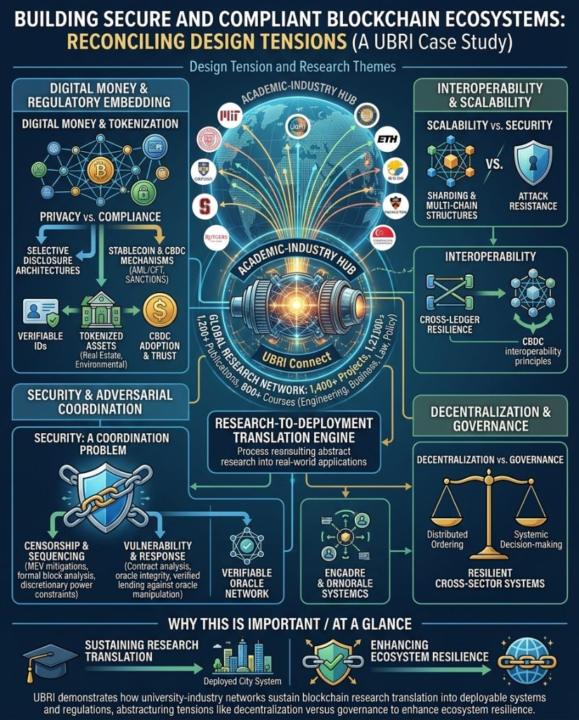
The University Blockchain Research Initiative (UBRI) represents a shift from theoretical speculation to institutional architecture. Spanning 60+ academic partners and 1,400+ projects, it bridges the gap between research and deployment. The core challenge is the reconciliation of fundamental design tensions: scalability versus security, and privacy versus regulatory compliance. Current outputs focus on "regulatory embedding." This includes selective disclosure for offline CBDCs and formal DeFi safety analysis under oracle deviations. Security is now framed as a coordination problem under adversarial conditions. Research covers protocol-level mitigations for MEV extraction and censorship-resistant sequencing. By synthesizing technical and institutional patterns, UBRI provides the blueprints for resilient production systems and cross-ledger interoperability. https://arxiv.org/abs/2604.21517 https://ripple.com/ubri/ https://ubriconnect.com/ https://arxiv.org/html/2604.21517v1
0
0
1-10 of 32
Active 5h ago
Joined Jul 20, 2025
ENTP
Seattle, Washington