User
Write something
Pinned
Welcome to the AI Faculty Breakroom ☕
Welcome to the AI Faculty Breakroom ☕ This is a space for educators who are thinking carefully about AI: not chasing every tool, not panicking about being left behind, and not pretending this transition is simpler than it actually is. If any of the following sounds familiar, this community was built for you: - "I can see how AI might be useful. I am just not sure yet how to use it well." - "Everyone else seems so certain, and I still have so many questions." - "I am already overwhelmed. I need this to actually help, not add to the pile." Thoughtful hesitation is not a deficit. It is exactly where good decisions begin. The Breakroom Vibe This community runs on kindness over impressiveness, curiosity over confidence, usefulness over trends, and calm over noise. There is no performance required, no standard to meet before speaking up, and no hierarchy based on how much anyone already knows about AI. Warm humans will always outrank impressive ones here. That is the culture this space is built on, and it is worth protecting. What Is Encouraged Here - Questions that feel too basic to ask anywhere else. - Half-formed ideas that need a safe place to land. - Honest reflections about what is working, what is not, and what still feels unclear. - Language that sounds like a real teacher, not a LinkedIn post. All of that belongs in this room. What Is Not the Vibe Spam, selling without consent, or anything that makes another educator feel small, behind, or less than. That kind of energy does not belong here, and it will not be allowed to stay. Our Shared Ground Rules - Teachers are not replaceable. - Students are not datasets. - AI supports thinking; it does not replace it. - Consent, privacy, and context matter in every classroom decision. - No one owes productivity or performance in this space. Welcome to the Breakroom. This community exists because educators deserve a place to think out loud without pressure, and I am genuinely glad it has found you. ☕
1
0
Pinned
My YouTube channel launches this week!
I launched a YouTube channel this week, three years after I first thought about doing it. Every excuse I had was some version of not enough time or not the right setup. The real reason was simpler: talking straight to a camera is a different kind of feeling exposed than writing a book chapter or speaking in my classroom. I did it anyway, because the same questions that built this community, and five books belongs on video too: What belongs to AI? What belongs to the teacher? and How does learning stays at the center of the classroom? The channel is @Kristina LeCrone New videos will publish twice a week, Please search for my channel, hit subscribe, and if you want fuller conversations, please post here! I haven't heard from most of you in quite a while, I would love to build this group around what you are working through in your own teaching practice.
0
0
My YouTube channel launches this week!
What did AI actually do for you this summer?
Staff room check-in before the break disappears completely: what did you actually use AI for this summer, if anything? Maybe it drafted a newsletter, or it helped you think through a hard email, and maybe you avoided it entirely and that was the right call too. No performance needed here, just the honest version.
0
0
What did AI actually do for you this summer?
The Trust Problem
Here's a number that stopped me this week: "88% of students are already using AI in their learning. Only 29% of them believe their teacher actually knows what to do about it." My first reaction wasn't calm, if I'm honest. It took me a minute to get there. Here's where I landed, and where I hope you land too: that gap was never a training problem. It's not about teachers falling behind on tools. It's a confidence and identity problem, and it's been building quietly for a while, in the space where nobody said anything clearly out loud. Students aren't losing trust because we don't know how to use the tools. They're losing trust because the standards have been implied instead of spoken. The fix was never catching up on the technology. It's standing on a framework, and having the conversation on purpose, the first day, instead of discovering the breakdown later and reaching for a detector. When you first read a stat like that one, what was your honest gut reaction, relief that someone finally said it, defensiveness, or something else entirely?
0
0
The First-Day Framework
I've tried the AI conversation with students more than once, and for a long time, none of it stuck. The stern version ("this is cheating, don't do it") felt like reading from a script I didn't write, and it didn't survive the week. The warm version ("just use it responsibly!") sounded nice and meant nothing; "responsibly" just hung there while students quietly wondered what it actually allowed. The detailed version, twenty minutes, eight slides, every possible use case, was airtight and completely unmemorable by the time anyone actually needed it. What finally worked didn't start with a rule at all. It started with purpose: naming out loud what I'm actually trying to help students learn before AI ever entered the conversation. Then we got honest about the gray areas instead of pretending every question has a clean answer because students can always tell when an adult is performing. One real conversation which took maybe fifteen minutes was done on day one and has done more for me than any policy I ever wrote to defend myself later. If you had to name, in one sentence, the actual capacity you're trying to develop in your students this year, what would it be, and have you said that sentence out loud to them yet?
0
0
1-23 of 23
powered by
AI Faculty Breakroom
skool.com/ai-faculty-breakroom-3921
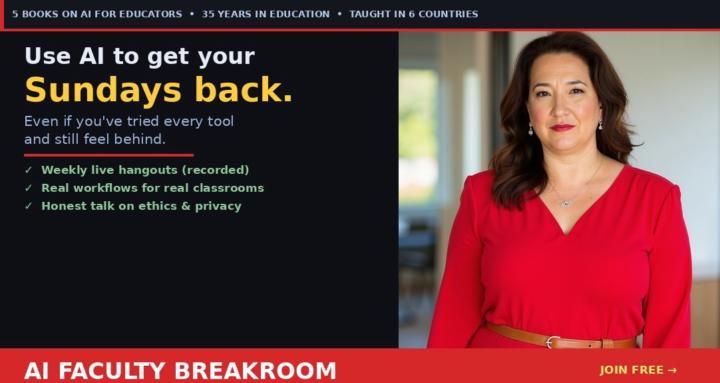
Free for teachers: AI finally explained by someone who's been in your classroom. #1 bestselling author. 35 yrs in education. No hype. Real talk.
Build your own community
Bring people together around your passion and get paid.
Powered by