
Write something

Aug 7 •
What ingnite the spark on me Today??
1. Kafka Learning - Studied Kafka through a crash course and learned its internal working, use cases, and when Kafka should or should not be implemented. 2. Docker CoW Mechanism - Learned about Copy-on-Write (CoW), snapshots, coalescing, and how Docker uses these concepts internally. 3. Docker Layering & Storage - Studied Docker image/container layering, storage consumption, and limitations of layered snapshots. 4. Docker Persistent Storage - Learned how Docker volumes and bind mounts provide persistent storage and protect data from container crashes/removal. 5. Technical Discussion – Discussed CoW, snapshots, Docker layering, and storage behavior with Mr. Sujai Sir to improve conceptual understanding.

🔥
Apr 27 •
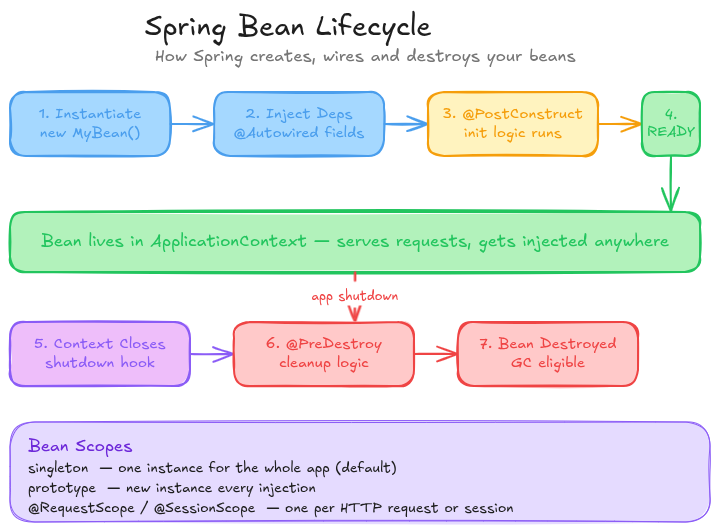
🫘Spring Bean Lifecycle
Every Spring Boot app you’ve ever run quietly creates, wires, and destroys objects for you, in other terms, this is Inversion of Control (IoC), a concept we’ll break down later. 1. Instantiation Spring creates the bean instance. 2. Dependency Injection Dependencies are injected (@Autowired, constructor injection, etc.). 3. Initialization (@PostConstruct) Custom setup logic runs after dependencies are ready. 4. Ready State Bean is fully initialized and used across the application. 5. Context Shutdown Application begins shutdown. 6. Cleanup (@PreDestroy) Cleanup logic runs (closing resources, connections). 7. Bean Destroyed Bean is removed and becomes eligible for garbage collection. Bean Scopes (Important) - Singleton (default): One instance per application - Prototype: New instance each time requested - Request / Session: Scoped to HTTP request or session

Mar 4 •
Facing error while setup API Gateway with spring boot 4
Enable API gateway with spring boot 4. Using maven <artifactId>spring-cloud-starter-gateway-server-webflux</artifactId> I need help please

Feb 12 •
Building a Cleaner Projection Layer on Top of JPA Criteria API
If you develop systems using Java with JPA, you have probably faced the need to execute queries that return only a subset of attributes from a given entity. At first glance, this may seem simple. However, when not handled properly, systems tend to accumulate redundant queries or methods that load entire entities when only a few attributes are actually needed. In many real-world scenarios, we often need to retrieve only fields like “id” and “name”. In large or complex systems, it becomes difficult to know whether a specific projection already exists. As a result, developers either duplicate queries or reuse methods that fetch more data than necessary. ProjectionQuery was created to address exactly this problem. It provides a clean and expressive way to define projection-based queries, helping you select only the data your application truly needs, in an organized and reusable way. If this resonates with challenges you’ve faced, I’d love for you to take a look at the documentation and the GitHub repository. Feel free to try it out, open issues, suggest improvements, or share your feedback. Contributions and ideas are always welcome!

Feb 1 •
Intro:
Hello Community Members, 1. I am based in Chicago, IL (USA) and work as a Java Engineer with over 2 years of experience primarily in backend development, along with some exposure to frontend technologies. 2. I have been seeking a knowledgeable and collaborative community to continue learning and growing, and this group strongly aligns with those goals. Brother Nelson Djalo’s commitment and dedication were a key inspiration for me to join and engage with this community. 3. I joined the Skool platform last year, and this is my first active community group. I look forward to participating meaningfully, learning from experienced members, and contributing where possible. Thank you for the opportunity to be part of this community.
1-15 of 15

skool.com/amigoscode
A free learning community led by Nelson Djalo. Master Programming & AI, get updates, and grow in a fast-moving industry.
Leaderboard (30-day)
1

+13
2

+5
3

+5
4

+3
5

+3
Powered by