
Write something
Pinned

May 19 •
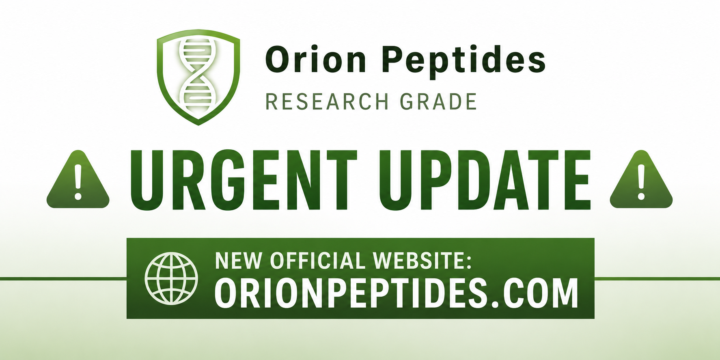
🚨 ORION PEPTIDES SERVICE UPDATE 🚨
Firstly, we want to sincerely apologize for the recent downtime and temporary interruption to our services. As Orion continues to grow, we needed to implement major backend and infrastructure changes to help us provide a faster, more secure, and more reliable experience moving forward. We’re happy to confirm that services have now been restored and we are officially back online under our new domain: Orion Peptides ✅ Ordering systems are operational ✅ Existing orders and support requests are still being handled normally ✅ Customer accounts and data remain secure ✅ Future updates and communications will come from our new domain These upgrades were necessary to help prepare Orion for future growth, improved security, and a smoother overall experience for our customers and research community. We truly appreciate everyone’s patience and continued support during this transition. For support or assistance: [email protected] — Orion Peptides
Pinned
Jan 6 •
🛑 Community Rules: Read Before Posting 🛑
Welcome to the team! To keep this space free, educational, and safe for everyone, please read and respect the following guidelines. We are here to research and learn, not to spam or endanger others. 1. NO Selling or Solicitation (Zero Tolerance)🚫 : - Do not use this group to sell your own products, promote your own affiliate links, or push "Underground Lab" (UGL) items. - Any member caught sliding into DMs to sell substances or unverified services will be banned immediately. 2. This is NOT Medical Advice ⚠️ - While I am a professional Biohacking Coach and Trainer, I am not a doctor, and neither are most members here. - Everything shared here is for informational, educational, and research purposes only. - Do not prescribe protocols to others as absolute medical fact. - Always consult with a qualified medical professional (like our partners at Optimal Clinic) before starting any new therapy. 3. Research & "Bro-Science" 🧪 - We love new experiments, but please distinguish between anecdotal experience (what worked for you) and scientific fact. - If you make a bold claim, try to back it up with a source or clearly state that it is just your personal experience. - Help us fight misinformation by calling out bad data respectfully. 4. Respect & Professionalism 🤝 - We are navigating a complex industry together. Treat fellow researchers with respect. - No flaming, harassment, or bullying. - Disagreements are fine; disrespect is not. 5. Privacy Matters 🔒 - Do not post private personal information (addresses, phone numbers, etc.) or sensitive payment details regarding vendors publicly. Keep the feed clean and safe. 🔒

20h •
12 weeks
12 weeks transformation Anyone looking for a Vendor with high quality HGH, Oils and Peptides with all COAs i highly recommend https://t.me/+mGDlCeAqbjEwMzJh


20h •
What Is BPC-157 and Why Is It So Widely Researched?
BPC-157 is one of those peptides that seems to come up constantly in research communities. It has attracted attention because researchers have investigated it across several areas, including tissue repair, gastrointestinal models, vascular processes, and cellular signaling. At the same time, there is a lot of confusion online about what BPC-157 actually is, what the research shows, and where claims go beyond the available evidence. So what makes BPC-157 interesting from a research perspective? What Is BPC-157? BPC-157 is a synthetic peptide that has primarily been investigated in preclinical research. Much of the interest surrounding it comes from animal and laboratory studies examining processes associated with tissue repair and cellular responses. It's important to distinguish this research from established clinical evidence. Findings from preclinical models don't automatically demonstrate that the same effects will occur in humans. That's one of the most important points to keep in mind when reading online discussions about BPC-157. Why Has It Attracted So Much Research Interest? One reason is the range of biological processes that have been investigated. Research has explored BPC-157 in areas such as: - Tissue repair - Gastrointestinal injury models - Vascular responses - Angiogenesis - Inflammation-related processes - Cellular signaling - Tendon and ligament injury models This broad range is part of what makes the peptide interesting to researchers. However, "studied in multiple areas" shouldn't be interpreted as "proven effective for multiple conditions." The strength and relevance of evidence can vary significantly between research models. BPC-157 and Tissue Repair Some of the most frequently discussed BPC-157 research involves tissue repair. Preclinical studies have investigated its effects in different injury models, including models involving muscle, tendon, ligament, and other tissues. Researchers have proposed several possible mechanisms for these observations, including effects involving blood vessels, cellular signaling, and inflammatory pathways.
0
0
20h •
Off Label vs Unapproved: Why BPC 157 Is Not an Off Label Prescription
Regulatory and Compliance In peptide medicine, terminology matters. One of the most important distinctions is between an off label use of an approved drug and the use of an unapproved drug. These terms are sometimes used interchangeably when discussing compounds such as BPC 157, but they describe very different regulatory situations. For practitioners, researchers, and patients, understanding that distinction is essential for accurate communication, informed consent, and regulatory compliance. What Does Off Label Actually Mean? Off label use occurs when a healthcare professional uses an FDA approved drug for a purpose, patient population, route, or dosing regimen that differs from the indication for which it received approval. The important point is that the underlying drug is still an approved pharmaceutical. For example, a drug approved for one medical condition may sometimes be prescribed for another condition when a physician determines that the use is medically appropriate. Off label prescribing is a recognized part of medical practice in the United States. BPC 157 is fundamentally different. BPC 157 has not received FDA approval for any medical indication in humans. Therefore, describing BPC 157 as an “off label prescription” is misleading because there is no FDA approved BPC 157 product or indication from which an off label use could arise. The more accurate regulatory description is that BPC 157 is an unapproved drug or investigational compound. That distinction is not merely semantic. BPC 157 Is Not an FDA Approved Drug BPC 157 has attracted considerable interest because of findings from laboratory and animal research involving processes such as tissue repair, inflammation, vascular biology, and gastrointestinal models. However, promising preclinical research does not equal FDA approval. FDA approval requires the agency to evaluate evidence concerning a drug's quality, safety, and effectiveness for specific proposed uses. BPC 157 has not gone through that process to the point of receiving an approved human medical indication.
1
0

1-30 of 1,342
powered by
skool.com/biohacking-and-longevity-group-3757
All-in-one peptide education community. 🧪
Dosing guides, storage protocols, stacking frameworks, vendor intel, GLP-1 research, and expert support.🧬
Suggested communities
Powered by