
Pinned

Apr 2 •
Introduction
Welcome to the MAUNI – London Recovery Coaching Campus on Skool. I’m @David Collins, and I’d like to invite you to join us as we explore the art and skill of recovery coaching. Below, you’ll find a short introduction from me, followed by a more in-depth 7-minute overview to help you better understand what we do and why it matters. We run live classes every Tuesday and Thursday morning—be sure to check the calendar above for the full schedule. You can also follow: @Tia Boulton for ongoing coaching supervision and support. @Paula Perkusic our CEO would also love to hear from you, please feel free to reach out to her anytime. We look forward to learning with you.
11
0
2d •
The Addiction Nobody Names Cont. - Part 5 and Conclusion
Part Five: A Coach's Closing Reflection If you recognise yourself anywhere in these pages - in the perfectionism, the managing, the bracing, the exhausting vigilance dressed up as competence - I want to say something plainly: this was never a character flaw. It was a strategy, and at some point in your life, it was probably a brilliant one. It kept a child safe in a house that wasn't predictable. It kept an adult functioning through chaos that might otherwise have swallowed them whole. Control earned its place in your life honestly. The work now isn't to shame the strategy out of existence. It's to thank it for its service and gently begin building something that doesn't cost you quite so much to maintain. That work starts with a handful of honest questions, asked without judgement: What am I actually trying to control here? What am I afraid will happen if I can't? What is that fear trying to protect? And - the one that tends to open the most doors - what would it look like to manage myself rather than control the world around me? These questions rarely produce comfortable answers on the first pass. That's fine. They aren't meant to be solved in an afternoon. They're meant to be lived with, returned to, and slowly answered through the accumulation of small, imperfect, repeated choices to do something other than grip tighter. Because here is the paradox at the very center of this whole conversation: we reach for control because we want freedom, and yet the tighter we grip, the smaller our freedom becomes. When every outcome has to go a certain way, there are fewer ways life is allowed to unfold. When every person has to behave according to our expectations, our closest relationships start to feel like negotiations instead of connections. When every uncertainty has to be eliminated before we can rest, ordinary life itself starts to feel like a threat. Freedom, it turns out, requires room — room for things to go differently than planned, room for other people to be exactly who they are, room for mistakes that don't have to mean catastrophe.
0
0

3d •
The Addiction Nobody Names Cont. - Part 4
Part Four: The Turn Toward Freedom The Difference Between Control and Commitment One of the most important distinctions in this work is the one between control and commitment. Control demands a guaranteed outcome. Commitment offers a consistent action, regardless of outcome. A person practicing control says, I will only be okay if this goes exactly as planned. A person practicing commitment says, I will show up, do the next right thing, and let the outcome be what it's going to be. The first position is brittle - it shatters the moment reality deviates from the plan, which reality does constantly. The second is durable, because it was never staked on certainty in the first place. This is also the deeper meaning behind the word surrender, which frightens so many people in recovery because it sounds like giving up. Clinically understood, surrender isn't passivity. It's the decision to stop spending finite energy trying to force reality into a shape it was never going to hold. A person who surrenders control can still set boundaries, still make plans, still leave unsafe situations, still ask for help, still show up fully for their own life. What changes is the reason behind the action. It's no longer an attempt to guarantee an outcome. It's an expression of a value. From "Control It" to "Manage My Response": A Simple Linguistic Shift with Real Power Language shapes the nervous system more than most people realize, and one of the simplest, most immediately usable tools in this work is a small vocabulary shift. Instead of asking how I can control this, try asking how I can manage my response to this. Instead of how I can control my emotions, try how do I regulate and respond to what I'm feeling. Instead of how I can make them understand, try how can I communicate clearly and accept whatever they do with it. The trigger doesn't change. The person's relationship to the trigger does. And that relationship - not the external circumstance - is almost always where the real suffering, and the real relief, lives.
0
0

5d •
The Addiction Nobody Names Cont. - Part 3
Part Three: The Cost of Staying in Charge The Body Keeps the Score of Vigilance Control is not only a mental habit; it lives in the body as a near-constant state of bracing. The clenched jaw. The shallow breath sitting high in the chest. The shoulders that never quite drop. The inability to sit still in a waiting room without checking a phone eleven times. This isn't a character trait - it's a nervous system that has learned, correctly at some point in its history, that letting the guard down was not safe. Telling a person in this state to simply "relax" rarely works, because their body has not yet been convinced that relaxing won't cost them something. Sometimes the unwinding must begin physically - in the breath, in the muscles, in the exhale - before it can become believable to the mind. Relationships Under Management Control, applied to another person, doesn't feel like control from the inside. It feels like love, or responsibility, or simply "knowing what's best." But relationships cannot breathe under management. A partner who is constantly steered, a child who is constantly monitored, a friend whose choices are constantly second-guessed - all of them eventually learn one of two responses: comply and disappear or resist and create the very conflict the controller was trying to prevent. Either way, genuine intimacy - the kind built on two people freely choosing each other, uncertainty and all - becomes almost impossible to sustain. The tragedy is that most people exerting this kind of control aren't trying to dominate anyone. They're trying to survive their own fear by managing its source, and the relationship absorbs the cost. The Depressor–Fixer Cycle and the Exhaustion of Constant Repair Many people caught in the control loop carry an internal voice I've come to think of as the depressor - the one that says you should have known better, this is unacceptable, you're behind where you should be. That voice produces shame with remarkable efficiency. And shame, being intolerable, summons its opposite number: the fixer. The fixer says, right, let's plan, let's solve this, let's control the situation before it gets worse. The fixer offers genuine, if temporary, relief from the shame the depressor created.
0
0

10d •
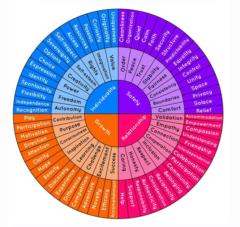
Human Feelings and Needs: Interactions and Intersections
The feelings and needs resources provide practical ways to understand and communicate what is happening within us. Through feelings wheels, needs inventories, and links between emotions, body sensations, and behavior, they help us develop emotional literacy—the ability to recognise, name, understand, and respond to our internal experiences. As a coach, I see these tools as a map and compass for the inner landscape. They help us move from reacting automatically to responding intentionally by showing us what is happening in our bodies, identifying the emotion beneath the reaction, and uncovering the need driving it. 1. The Feelings Framework: Mapping the Inner Landscape Healthy coping and emotional regulation begin with being able to identify what we are experiencing. The resources offer several complementary ways to develop greater emotional awareness. The Somatic and Behavioural Connection – Feelings Wheel 2.0 This tool reminds us that emotions are not simply thoughts; they are also physical experiences. It connects core emotions such as sadness, anger, fear, joy, power, and peace with bodily sensations and the behaviours they may trigger. For example, a racing heart, tight muscles, or a feeling of heat may accompany anger or fear, while a heavy or empty feeling in the chest may accompany sadness. Calm breathing, physical openness, and an upright posture may accompany peace or a sense of empowerment. Recognising these physical signals gives us an opportunity to pause before automatically moving into fight, flight, freeze, withdrawal, defence, or other habitual responses. The Classic Feelings Wheel The feelings wheel expands our emotional vocabulary. Instead of simply saying we feel “good” or “bad,” it helps us identify what we are actually experiencing. What initially feels like “bad,” for example, may be stress, tiredness, boredom, overwhelm, or a sense of being out of control. The more accurately we can name an emotion, the easier it becomes to understand and respond to it.
0
0

1-30 of 140
skool.com/london-recovery-coaching
Turning lived experience into professional careers. Train - Empower - Treat.
Leaderboard (30-day)
1
+1
Powered by