Activity
Mon
Wed
Fri
Sun
Oct
Nov
Dec
Jan
Feb
Mar
Apr
May
Jun
Jul
Aug
Sep
What is this?
Less
More
The SKOOL Directory
965 members • Free
📚The Skool Bookshop
192 members • Free
LlynFay Inc. Marketplace
451 members • Free
Activity Book Creator Lab
395 members • Free
AI for Beginners
1.4k members • Free
Book Design Like a Pro
312 members • Free
BookVillage - Amazon Reviews
455 members • Free
Ricochet
218 members • Free
Kidlit Author Growth Academy
1.4k members • Free
11 contributions to Oasis Builders
🔥
1d •
Before It Reached Your Plate
This morning I was thinking about how easy it is for many to see food only as the finished product. Take something ordinary, maybe a tomato, a slice of bread, a bowl of beans, or even something already prepared from the grocery store. Before it reached our plate, there was a story. Someone grew, raised, gathered, harvested, caught, processed, or prepared what eventually became this food where soil, water, weather, and season all played a part. Someone harvested, transported, processed, packaged, sold, or prepared the food. Then somewhere along that path, we became part of the process too. We may have grown it ourselves. We may have bought it from a farmer. We may have chosen it from a grocery shelf, brought it home, cooked it, or simply opened the package. What interests me is what happens when we begin to notice the relationships again. Pick one thing you eat today and trace it backward as far as you reasonably can. Where did it come from? Who might have had a hand in getting it to you? Was season important to it? What happened between its original form and what is sitting in front of you, and where did you enter that chain? You do not need to research every answer. Start with what you know, notice what you do not know, and let the missing pieces become questions. My thought is that food literacy begins partly here, not by memorizing more rules about food, but by becoming curious about the food already passing through our hands. What is one ordinary food you could trace backward today, and how far back can you follow it? When you think about the food you eat most often, how well do you know its path to your table?
Poll
13 members have voted

7 likes • 1d
When I want a fresh garden tomato or head of cabbage - these days I go fishing. I have a neighbor from the VIrgin Islands who grows a fabulous garden. Better than any of mine when I did have gardens. Here's how it goes... I go fishing in the Gulf and catch some tasty fish like snapper or grouper, fillet them out and take them to my neighbor (his name is Luis). Within a couple days Luis shows up with tomatoes, lettuce, cabbage or whatever he has growing (it's Florida so he grows year round). Works for me - and him. Instead of having dirt caked hands, I have stinky fish hands... :-)
2 likes • 5h
@Jim Flach smiling makes your garden grow!
🔥
May 25 •
Memorial Day
Today we pause with gratitude for the men and women who gave their lives and service to our country. Memorial Day is not just a long weekend. It is a day to remember the cost carried by families, and communities, to promote freedom throughout the world. At Oasis Builders, we talk about home, family, land, and building steady lives. Days like this remind us that much of what we are able to build rests on sacrifices we should never forget. With respect and gratitude, we remember.
5 likes • May 25
@Evelene Sterling
Mar 15 •
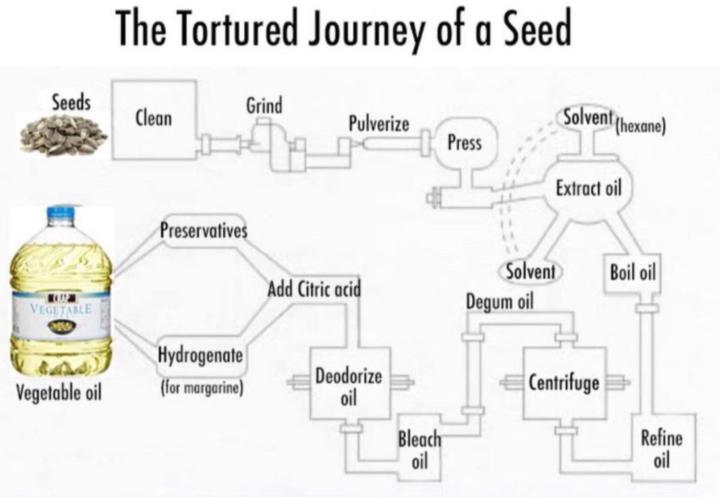
Why seed oils are not good for you
Seed (vegetable) oils are almost entirely fat and provide concentrated calories, with very little protein, carbohydrate, or micronutrients per tablespoon. What “seed vegetable oil” means Most cooking “vegetable oils” sold in bottles are blends or single oils made from seeds such as soybean, corn, canola (rapeseed), sunflower, safflower, grapeseed, cottonseed, or sesame. Their detailed composition varies by plant, but they share some broad features. Typical nutrition per tablespoon For a generic vegetable/seed oil (about 14 g fat per 1 tablespoon / 15 mL): - Energy: ~120 calories per tablespoon - Total fat: ~14 g - Protein: 0 g - Carbohydrate: 0 g (0 g fiber, 0 g sugars) - Cholesterol: 0 mg - Sodium: 0 mg All of the calories come from fat. Fatty acid profile (general pattern) Seed oils are predominantly unsaturated fats, with relatively low saturated fat compared to animal fats like butter.
2 likes • Mar 15
@Jim Flach no - it is equally healthy as olive oil
2 likes • Mar 15
@Jim Flach Yes fusing some fresh herbs like rosemary and basil are excellent. Avocado oil also has a higher flash point than olive oil.
5 likes • Feb 28
HA! Ha! My favorite tool this time of year in Florida is my fishing rod. That's because I have a neighbor who has a great garden. I trade him fish I catch for garden veggies. WIN - WIN.
2 likes • Feb 28
@Jim Flach My Uncle (his name is Waldo) used to do the same and often skipped school to fish. IN those days they had truant officers who came looking for you. They would show up at my Grandmother's (his mother) home and say "Waldo doesn't seem to be in school today. Do you know where he is?" She would shrug her shoulders and they would leave. Years later I fished with my uncle often and he would tell me this story... and laugh and laugh. "I went to school to learn to fish" he would say.
1-10 of 11

@al-anderson-3117
Story crafter and teacher of using AI to create short children's stories and adult intrigues.
Serial entrepreneur and still learning new things!
Active 2h ago
Joined Jan 3, 2026