Activity
Mon
Wed
Fri
Sun
Nov
Dec
Jan
Feb
Mar
Apr
May
Jun
Jul
Aug
Sep
Oct
What is this?
Less
More
OPTIMIZE & THRIVE
6.2k
5.0
Free
Jamie's Peptide Education
292
Free
Peptide Intelligence-OB
49
Free
Peptides for Newbies
8.2k
Free
Peptide Coaching Hub
65
Free
Peptide of The Week Community
17.1k
5.0
Free
Peptides: Out of the Shadows
126
Free
3 contributions to Peptides: Out of the Shadows

21d •
🔴 PLAYBOOK A — REPAIR THE ENGINE
SS-31 Mitochondrial Restoration Once the mitochondrial assessment points toward impaired mitochondrial function, the objective changes from optimization to restoration. This is where SS-31 (Elamipretide) comes into the picture. 🔧 SS-31 — THE ENGINE REPAIR KIT SS-31 is a mitochondrial-targeted peptide with an affinity for the inner mitochondrial membrane—the highly folded internal membrane where the electron transport chain operates and most cellular ATP is produced. Central to that membrane is cardiolipin. Cardiolipin is a unique and essential phospholipid found almost exclusively within the inner mitochondrial membrane, where it accounts for roughly 20% of its lipid composition. It is often referred to as the “signature lipid” of mitochondria because of the important role it plays in mitochondrial structure and cellular energy production. Cardiolipin helps organize and stabilize the inner mitochondrial membrane and supports the protein complexes that make up the electron transport chain—the machinery responsible for producing most of our ATP. When cardiolipin becomes damaged or oxidized, that organization can begin to break down. Electron transport becomes less efficient, oxidative stress can increase, and the mitochondria may become less efficient at converting nutrients and oxygen into usable cellular energy. This is the environment SS-31 targets. SS-31 interacts with cardiolipin at the inner mitochondrial membrane. Research suggests this interaction can help stabilize the membrane environment, support the organization and function of the respiratory machinery, improve mitochondrial bioenergetics and reduce excessive mitochondrial oxidative stress. The potential result is a mitochondrial environment better equipped to do what it was designed to do: Produce ATP efficiently. That's why SS-31 fits the Repair the Engine concept. We're not trying to push the engine harder. We're working on the machinery responsible for producing the power in the first place. ⚙️ THE 8-WEEK SS-31 RESTORATION PROTOCOL


0 likes • 9d
@Adam Serge Just ordered this with Mots-C. I am currently on Tirz. The Reta gave me anhedonia from the glucagon it contains. I am also on nad and GHKCU. Will taking SS-31 and Mots-C give me any of those side effects?
12d •
THE RETATRUTIDE BATTLE IS BECOMING MUCH BIGGER THAN RETATRUTIDE
Eli Lilly is locked in a high-stakes legal battle with the FDA over the classification of retatrutide, and the dispute is reaching a critical point. But there are actually two battles taking place over retatrutide right now. One is being fought in federal court over whether retatrutide should legally be classified as a biologic rather than a traditional chemical drug. The other is already being fought in the marketplace—against the underground supply chain selling retatrutide before Lilly has even received FDA approval. And the two battles may be far more connected than they initially appear. At first glance, the legal dispute sounds like boring corporate bureaucracy. It isn't. This is potentially a multi-billion-dollar fight over market exclusivity, compounding, and ultimately who controls access to retatrutide once it reaches the legitimate pharmaceutical market. 🔬 THE SCIENCE ARGUMENT: "COUNTING AMINO ACIDS" Believe it or not, a major part of this legal fight comes down to counting chemistry links. The FDA defines a "protein"—which can qualify a medicine as a biological product—as a chain containing 40 or more alpha amino acids. Here's the disagreement. LILLY'S POSITION - Retatrutide contains 41 amino acids in total. Therefore, Lilly argues that retatrutide meets the definition necessary to be classified as a biologic. FDA'S POSITION - The FDA rejected that interpretation. The agency argues that retatrutide's structure consists of a main backbone containing 39 alpha amino acids, plus a small side chain containing another 2 amino acids, where at least one is not an alpha amino acid. Therefore, under the FDA's interpretation, retatrutide does not cross the 40-alpha-amino-acid threshold required to meet the definition. 41 versus 39. That seemingly tiny distinction has enormous commercial consequences. ⚖️ THE COURT BATTLE: WHERE IT STANDS The legal fight has already gone back and forth. Lilly sued the FDA in late 2024. In September 2025, a federal district court issued a split decision.
1 like • 9d
No matter what reta will be out there. Govt is just mad they're not making the money gray markets are making today. Govt is corrupt. Just saying.
May 13 •
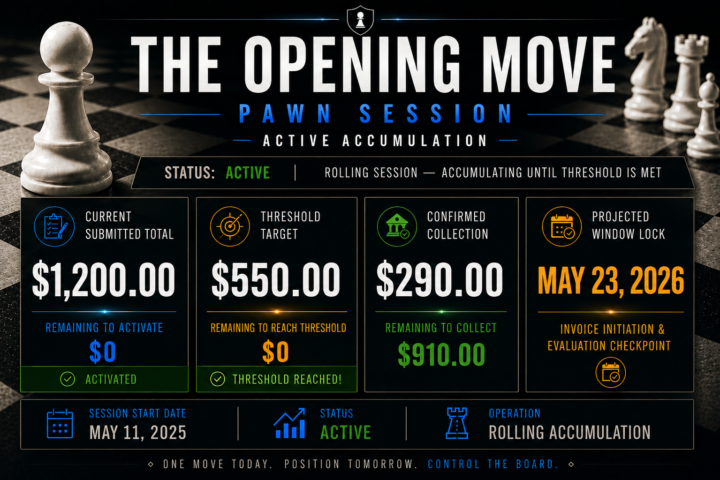
The Pawn Session (May 2026) – Consolidated Rolling Kit Buy
Consolidated Rolling Kit Buy — The Pawn Session – (May 2026) Opening session DOES NOT LOCK for the first 10 days. If on the May 23rd, the threshold has not been met, the cycle remains open. CURRENT PRODUCTS AVAILABLE FOR THIS SESSION Product Name Kit Cost 5-Amino -1MQ 50mg -- $80.00 GLPRETA 10mg --$95.00 GLPRETA 15mg -- $120.00 GLPRETA 20mg -- $135.00 GLPRETA 30mg -- $155.00 Glutathione 1500mg -- $85.00 KPV 10mg -- $65.00 Mots-c 10mg -- $65.00 Mots-c 40mg -- $145.00 NAD+ 500mg -- $80.00 Thymosin Alpha-1 5mg -- $80.00 Thymosin Alpha-1 10mg -- $125.00 • Standard VENDOR shipping: ~$60 - FedEx VENDOR shipping: ~$95 • Vendor states shipping becomes free once consolidated orders reach 25 total kits per order. • Vendor states one free reship if customs seizure/confiscation occurs • No vendor-supplied 3rd party COA documentation currently provided Current Execution Threshold: • Approximate combined rolling order target: $550 • Once rolling submissions approach threshold level, payment requests will be issued • Orders are submitted once payment confirmations are completed KEY SESSION MECHANIC Once a session locks, the international shipping fee (Vendors Shipping Fee) is proportionally diluted across all participating orders within that locked session. The greater the participation level at lock: the lower the effective shipping exposure per participant. Fees: • Flat $20 Administrative Fee per participant • Domestic redistribution shipping selected during intake and added to final invoice Important: No vendor listing should be interpreted as guaranteed quality, purity, batch continuity, or independent Dark Horse verification. Independent testing is always encouraged whenever possible. Please refer to the Classroom guide on Testing, Verification & Chain of Custody for additional discussion and reference material. [Intake Form Link] https://docs.google.com/forms/d/e/1FAIpQLSe-HNroxJpyxGkN7CTqd6LZZhYMnvNXGRMpUyMFyZpcj8rukA/viewform?usp=header
0 likes • May 14
Shipping is extremely high. Plus administrative fee. Is this supposed to be a group buy?
1-3 of 3
@carmen-snow-4338
Retired Probation Officer. Current Real Estate Investor. Seeking knowledge and learning on others about the healthy life of Peptides.
Active 5d ago
Joined Apr 30, 2026