Activity
Mon
Wed
Fri
Sun
Oct
Nov
Dec
Jan
Feb
Mar
Apr
May
Jun
Jul
Aug
What is this?
Less
More
Ruth Performance Lab
355 members • Free
7 contributions to Ruth Performance Lab
18d •
What actually eats most of your programming time?
For the last few months, I’ve been paying closer attention to how I spend my programming time and I’ve been trying to answer one simple question: What task or problem eats the most time? The more I paid attention to what I was doing, the more I noticed it wasn't high-level planning or deciding whether to progress an athlete or pull-back. It was rebuilding things I’ve already built! Writing a week without a well-defined mesocycle or template immediately turns it into a crippling blank-page exercise. Then I find myself trying to invent a new week layout or progression for a problem I’ve already solved dozens of times. Sometimes this is because the solutions I've built aren't organized well enough to find and sometimes because I'm focused getting the week layout right rather than building the actual week. The physical process of building the program often takes significantly longer than deciding what the program needs to accomplish. Reading an athlete’s feedback, understanding how they’re adapting, and deciding whether to continue progressing, back off, or make a structural change takes time. However, that’s also the part of the coaching process where we deliver the most value to the people we're guiding, so I'd rather focus my time there than re-typing the same solution to a problem over again. The distinction I keep coming back to is this: Individualized coaching doesn’t require inventing a new solution every week. It requires: - A well-defined plan - A library of proven progressions - Clear rules for selecting and adapting them - Enough attention to athlete feedback to know when the plan needs to change Interestingly, I looked back through several of my mentorship conversations, and this same problem appeared over and over again. The most common recommendation I’ve made to other coaches is to stop programming from a blank page and start building a searchable library from the work they’re already doing. Write it once, save it in a place you can access it again, organize it, then adapt it for a client's unique situation.
1 like • 15d
Im pretty much a programming geek and i enjoy building programs overall and create templates and solutions to everything through already built and ready templates. I've created a yearly template for crossfit aspiring athletes in Quarter up to Semi level .. with many options and pathways for different levels and types. 1. that freed up most of the deciding and building time. So most of it goes to chatting with clients for anything from questions to reviewing videos giving feedback etc.. I do update the client programs weekly, even though i follow the template to some degree as a guidline - some things need attention from feedback in this way or another. Things im building from scratch or at leats working on workout-to-workout basis and updating "on the go" are when i need to refine or teach movements. Like re-teaching the Weightlifting\Gymnastics movements or actually teaching them from 0. I dont have a proper template to go by for those and i always write it all again everytime.. Here i can say that sometimes i wish i had something ready. as many times the proccess repeats itself... but also sometimes it does go very different and requires "out of the box" (or out of the template in this case) thinking and applying - i enjoy when it gets difficult.. and wish i had a template when its easy and everything goes to smooth... 😅 Also lacking in client boarding - need to find time to create a proper boarding protocol\questionere etc.. Most of my actual "Programming" time is actually spent on my free time since i really enjoy doing it .. like building Legos but in Sheets, Im not too savy in Sheets but i can color boxes and use all my OCD into that with what feel like the "right" order in everything... without anyone judging. Although i had a coach here and there but mostly program for myself for the simple reason that i really want to do all those creations too.
Apr 4 •
The BEST Rip Repair
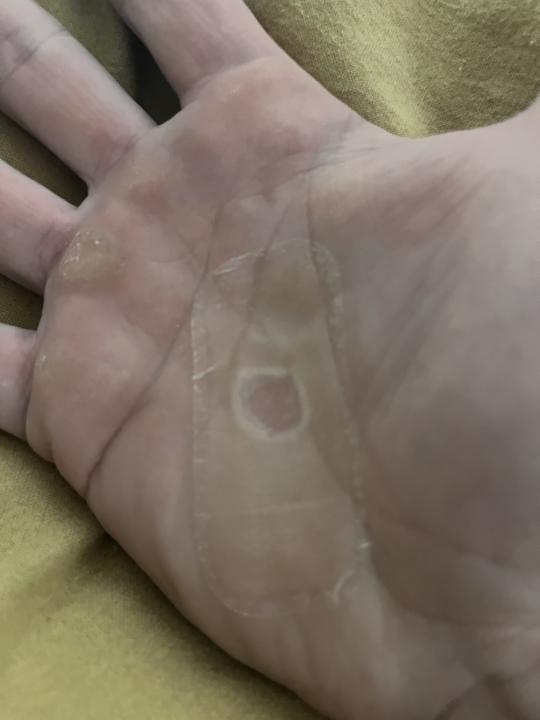
My youngest daughter got a rip last week playing on the bars during QF and I needed a way to help it heal without some of the headaches we always deal with - skin cracking, reopening, etc… Normally I just use skin glue - it stings BAD but once it dries the rip heals under it pretty fast, and during comps it makes it so you can compete without thinking about it or bleeding everywhere. But it stings so bad I didn’t think it was an option for a kid. I had these hydrocolloid bandages sitting around in our first aid kit so I decided to try it on her. Zero pain, stayed on extremely well, and the fastest rip healing I’ve seen. I got a pretty good rip in my Thursday session and slapped one on - so far zero pain, and it’s keeping the moisture up so I’m assuming no cracking and it’ll heal fast. Just wanted to share since dealing with rips can be a huge pain and sometimes they linger forever. Anyone else have tips for rips?
0 likes • Apr 5
From doing too many tattoos I discovered something called Second-Skin. Looks similar to this bandage. You can cut it however you want to fit any place. You can layer it too. You slap it on like bandage .. and basically like the name it's like another layer of skin on your skin. It won't hold if you abuse it but it can keep the place clean and moist. Probably won't hold more than a couple days on the hand but you can always put another piece. We always have some cream for skin tears, used different stuff.. all the same from what i've experienced.
Apr 3 •
Post QF Focus?
I’m curious about what everyone’s focus is post QF? Athletes: if you’re not moving on to semifinals - what is your plan for the “off season”? Will you compete this year in some in-person events? Dabble in Hyrox? ATHX? Xenom?! (The name 😂) Coaches: what are you preparing your athletes for? What is the primary training focus for your clients as you shift into the off season?
1 like • Apr 5
Coming from a small country we barely have semi - level athletes. But the whole yearly prep for our CF community here rotates around 1 big competition in June. So most of what i'd call Quarter-level athletes are in mid prep for the Qualifiers next month or the higher top that soon to start the prep for the comp. Myself going for FTD Master 35-39 next month (hopefully if ... Say geopolitics won't interfere, which unfortunately is highly probable) And already dreaming about a nice quality proper off-season, I always enjoy it way more.
Jan 11 •
Stim Matters: The Deadlift Deep Dive
This week @Ryne Sullivan and I dedicated the entire episode to deadlift inside of competitive CrossFit context. We covered everything from assessment --> programming for strength vs capacity --> technical issues --> and A TON more. In the episode I promised I'd provide a copy of my internal notes that I put together before the show, so I wanted to post those here for anyone who wanted them AND as a way to stimulate discussion. I'm really curious about how other coaches in the space approach "the deadlift problem" for competitors -- how frequently do you attack the movement? What are the principles or pillars you use for programming? Do you view the capacity vs absolute strength debate through a different framework? Episode link: CLICK HERE TO WATCH Notes below: ----------------------------------- 1. SEPARATE THE PROBLEM: STRENGTH VS CAPACITY ----------------------------------- Treat deadlift strength and deadlift capacity as two different adaptations. Strength - Neural output - Confidence in heavy positions Capacity - Repeatability of hinging under fatigue - Often shows up inside mixed-modal work Trying to solve both with the same tool is the mistake. Key takeaway: If you want to get someone stronger, you need to address the neural aspects of strength. If you want them to be able to repeat deadlift under fatigue, that's a 2nd order problem of metabolic demand + strength requirement. ----------------------------------- 2. DEADLIFT STRENGTH IS PRIMARILY A NEURAL PROBLEM ----------------------------------- Move away from high-volume deadlift strength work! What not to do: - High-rep tempo deadlifts (useless for building top-end strength in a healthy well trained athlete) - Large weekly deadlift volume “to get stronger” - Treating deadlift like a hypertrophy lift What to do: - Heavy singles, doubles, triples -80%+ of 1RM 5+ sets per week - Hand-release or full reset reps (no touch-and-go)
2 likes • Mar 21
Usually In Crossfit i program the deadlift as a skill from a heavy exposure perspective I want the athlete to know how to deadlift well. Rarely do I want them to go really heavy or actually test 1-3RMs In that regard I push strength through Squats and if the athlete need more posterior chain focus than I'll do it with other exercises and deadlift variations but not just deadlift from the floor. So Squats and posterior chain exercises to build the absolute STR if the deadlift, using the actual skill of deadlift a Max weight rarely but I do throw it in a 6-8 rpe format weekly or biweekly depends on how strong the athlete is or how much of an issue the exercise is itself .. if it is. If I want to really push it hard I'll usually use Clean/Snatch deadlift variations and just throw them more frequently. I don't take a hard note on sticky points in the deadlift as I don't see it really matter that much to train through the deadlift itself. If an athlete shows weakness in a specific point of the lift for me it usually points out a general weakness that I just need to pay attention to. Weak glute,back,legs etc... Pushing specific work for it through the deadlift to add 5-10kg to the lift makes no sense to me as I rather push strength through other ways -ways which also will improve the athletes other lifts as well. So I always rather see 5-10kg increase In the squat instead and the deadlift will follow.. as many other lifts. top end deadlift str been seen really rarely and the time-effort-fatigue doesn't worth it in most cases. Only the top athletes In the world has the opportunity to show deadlift top end STR up until now, no? Maybe some local comps too but I'm very posterior dominant and I deadlifted 300kg , haven't once met it in a crossfit comp for 12 years myself, I wish though... I do feel comfortable pushing volume and reps and tempo in the deadlift for begginers. So mostly I approach the deadlift as a capacity skill after the begginers phase. Depends on the person and the quality of his deadlift movement I can begin is journey just with high reps , then move to density work as emoms-for time and such..
Mar 4 •
Case Discussion: Athlete With Multiple Injuries – SI Joint Pain Limiting Unilateral Work
Hi everyone, I’d appreciate some input on a case I’m about to start working with. I’m beginning with a new athlete. I completed the TTT Movement Course, so I plan to apply principles from the Fives model, but I’d also like to open this up for discussion and hear additional perspectives on approach and progressions. She is 45 years old, previously competed in CrossFit, and her goal for the coming year is simply to return to consistent, enjoyable training without pain. Current issues: • SI Joint inflammation (Sacroiliac Joint) – at one point there was even concern about possible arthritis• Partial labrum tear in the shoulder – no pain in internal rotation, but external rotation is painful Movement observations so far: • She can perform most bilateral lower-body movements until the load becomes painful• Unilateral lower-body work is currently not possible (split squats, lunges, SL RDL, SL hip thrusts)• Running is not currently an option due to pelvic pain During the initial assessment I tried to identify a pelvic imbalance, but didn’t see any major asymmetry in the 90/90 testing. The pain during unilateral work appears to be immediate during execution, rather than delayed soreness. Programming-wise, I’m fairly confident in the overall direction. The template will likely emphasize: • Freedom / Variability / Self-Mastery• Isometrics and tempo work• Extensive hip and ankle mobility• Very controlled, foundational strength work I still need to complete my full movement assessment battery, including the additional tests I incorporated after the TTT movement course. My main questions: 1. Why do you think unilateral work might currently be such a major limitation here? 2. How would you approach progressing it back in? 3. Is there anything else you would consider prioritizing in this situation? I already have a general structure in mind, but I’d really appreciate hearing how others might approach a case like this.
1 like • Mar 5
Can't answer for 1 But 2. Did you try regressing and check just isometric holds? No added weight. Just holds , bracing and breathing.. Maybe then introduce isometric efforts, building from light effort into max effort. A while after that going with eccentrics and slowly try low rom unloaded full motions slowly building to full motion with no loads. As an idea for regression then progression
1-7 of 7