Activity
Mon
Wed
Fri
Sun
Oct
Nov
Dec
Jan
Feb
Mar
Apr
May
Jun
Jul
Aug
What is this?
Less
More
Future Producer Society
78 members • Free
20 contributions to Future Producer Society

10d •
YouTube Is Changing. Music Creators Should Be Building for What Comes Next.
There’s a lot of conversation right now about changes coming to YouTube monetization. For music creators, I think the bigger lesson goes beyond whatever number YouTube ultimately puts on watch hours, subscribers, or Shorts views. The era of simply uploading content and hoping the algorithm eventually rewards you is becoming harder to sustain. If you're a producer, artist, songwriter, engineer, DJ, music educator, or anyone building a business around music, your YouTube channel should be treated like a content catalog, not just a place to upload videos. Here are a few things I would be doing right now. 1. Start optimizing for WATCH TIME, not just views. A video getting 10,000 views sounds great. But if people watch for 30 seconds and leave, that audience isn't nearly as valuable as 1,000 people spending 15 or 20 minutes with your content. Music creators actually have an advantage here because we naturally create content people can spend time with. Beatmaking sessions. Studio sessions. Production breakdowns. Music business tutorials. Song breakdowns. Beat tapes. Listening sessions. Live reviews. Interviews. Long-form educational content. Don't automatically chop everything into short content because everyone tells you attention spans are dead. Short-form can get attention. Long-form builds watch time, familiarity, and trust. You need both. 2. Turn individual videos into a SERIES. One of the biggest mistakes I see creators make is treating every upload like an isolated piece of content. Instead of: "How I Made This Beat" Think: Making a Beat From Scratch — Episode 1 Then Episode 2. Then Episode 3. Now build a playlist around it. Do the same thing with mixing tutorials, music business education, sample breakdowns, studio sessions, artist development, songwriting, or whatever your expertise happens to be. Your goal shouldn't always be getting somebody to watch one video. Your goal should be: Watch this → then watch this → then watch this. That's how you start turning a YouTube channel into something closer to your own television network.


1 like • 7d
@Rick Chestnutt agreed
22d •
Studio Equipment
Any recommendations on the best places to sell older studio gear? I’m looking to upgrade a few pieces of my setup and would love to hear what platforms you’ve had the best luck with.
2 likes • 22d
@Rick Chestnutt I appreciate the knowledge bro. And makes sense. I need the space but you got me thinking about other options. Appreciate it King 👊🏾
2 likes • 22d
Facts. Never know when this equipment may circle back. I’m glad I came here to get feedback first ❤️🔥👊🏾
Jul 31 •
Every Beat Is an Asset
One of the biggest mindset shifts I've had over the past year is this: Stop thinking of every beat as content. Start thinking of every beat as an asset. Content is made to get views. Assets are built to create value over time. When I first started making beats, I was focused on finishing the music. Once the export was done, I felt like the job was over. The more I've learned about this business, the more I've realized that's actually when the work begins. An asset has to be managed. That means making sure: - You actually own what you created. - Your split sheets are completed. - Your metadata is accurate. - Your publishing is registered. - Your PRO information is current. - Your contracts are organized. - Your royalty accounts are set up. - Your payment information is ready before the money starts flowing. Think about it this way... If someone owned a rental property, they wouldn't buy the house and then forget about the deed, insurance, taxes, or maintenance. They protect it because it's expected to generate income. Music deserves the same mindset. Every beat you finish has the potential to become something bigger: - A placement. - A sync license. - A sample. - A remix. - A commercial. - A TV cue. - An artist record. - Or income you haven't even imagined yet. But potential only matters if you've done the work to protect it. I'm realizing that producers don't just build catalogs. We build portfolios of assets. And assets need documentation, administration, protection, and periodic review—not just great drums and melodies. What's one thing you've started doing to treat your music more like an asset than just another upload?

2 likes • Jul 31
Powerful insight and valuable information. Thanks for taking the time to share it!
Jun 2 •
The Producers Getting Placements Aren’t Necessarily More Talented
A hard truth a lot of producers eventually learn is that placements rarely go to the most talented person in the room. They usually go to the producer who feels the easiest to work with. In today’s music industry, perception matters almost as much as the music itself. When an artist, manager, A&R, or music supervisor receives your beats, they’re not just hearing the production. They’re subconsciously evaluating the entire experience around it. Does the producer feel organized? Professional? Consistent? Prepared? A lot of talented producers lose opportunities before the beat even drops because their presentation creates friction. Sloppy file names, broken links, missing metadata, no branding, inconsistent communication, random delivery methods — all of those things quietly signal “unprepared,” even when the music is strong. Meanwhile, another producer with comparable skill level sends over a clean package with professional artwork, organized files, BPM and key labeled correctly, and a polished delivery experience. Instantly, they feel more trustworthy. More established. More serious. That matters. Because the industry is overloaded with music now. There are millions of uploads fighting for attention every month. Talent alone no longer creates separation. Professionalism does. The producers building momentum right now understand that music is no longer just art. It’s presentation, positioning, branding, and systems working together. That doesn’t mean becoming fake or overly corporate. It means respecting your work enough to package it correctly. A producer with a well-positioned catalog will outperform a producer with better beats but no structure almost every time over the long run. That’s one of the biggest shifts happening in the producer space right now. The winners aren’t always making more music. They’re making their music easier to trust, easier to consume, and easier to place. We spend a lot of time breaking down the side of music production most producers overlook — branding, packaging, positioning, catalog strategy, placements, monetization, and professional systems.
0 likes • Jun 8
Great perspective and guidance here! Presentation goes a long way especially as it pertains to branding ourselves as a collaborative producer or an artist. Makes sense. Appreciate you sharing!
May 9 •
Native Instruments Just Got Acquired: Here's What It Means for Producers
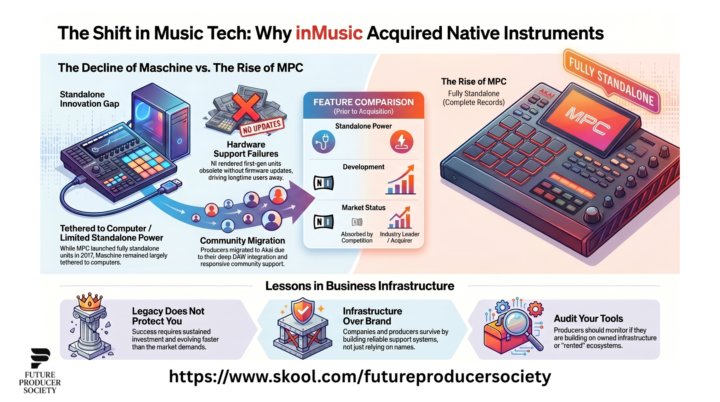
WHAT HAPPENED Native Instruments, (the company behind Maschine, Komplete, and Traktor) just signed a definitive agreement to be acquired by inMusic. If that name doesn't ring a bell immediately, their portfolio will. inMusic owns Akai Professional, Moog Music, Denon DJ, Numark, Rane, and M-Audio. They now own the MPC ecosystem AND the Maschine ecosystem under one roof. I CALLED THIS I've been saying this for years. When a hardware company stops innovating fast enough, they don't survive ,they get absorbed. I watched it happen in real time. My first generation Maschine unit was rendered completely useless when I upgraded my CPU. No firmware update. No support. No path forward. That was over ten years ago. That's not a bug, that's a strategy failure. When you stop serving the people who built your brand, you lose the brand. WHY THIS HAPPENED Native Instruments spent years as one of the most dominant forces in music production software and hardware. But while the MPC was evolving into a standalone production powerhouse with continuous firmware updates, Maschine stagnated. The hardware fell behind. The software ecosystem got bloated. The community started migrating. Meanwhile inMusic kept investing in the MPC line — standalone operation, continuous updates, deeper DAW integration. The market made its decision before the acquisition papers were ever signed. WHAT THIS MEANS FOR PRODUCERS The brands will continue operating — NI, iZotope, Plugin Alliance, Brainworx all stay intact for now. But the consolidation of Maschine and MPC under one parent company is a massive shift in the hardware production landscape. A few things to watch: - Will inMusic unify the NKS and MPC ecosystems into something bigger? - Does Maschine get the firmware investment it's been missing? - How does this affect pricing and competition in the hardware market? - What happens to the NI software ecosystem long term? THE BIGGER LESSON This isn't just a music tech story. It's a business story every producer needs to understand. The companies that survive in this industry are the ones that keep serving their community with innovation. The moment you start coasting on your legacy, someone else is already building what your customers actually need. That's true for hardware companies. It's true for labels. And it's true for producers who aren't building their business infrastructure while they're still relevant.
Poll
8 members have voted
1 like • May 12
Thanks for sharing l! This one hit home for me because I started with Maschine and used it heavily for about 9 years. I honestly enjoyed the workflow and learned a lot from it creatively. But after switching to the MPC about 3 months ago, it completely opened my eyes to what I was missing in terms of speed, control, and overall workflow quality. Curious to see what happens next now that both ecosystems are under the same umbrella.
1-10 of 20

@kazz-milz-6641
Music is an extension of my soul. I do this because I love sounds of melodies mixing together for a piece of Sound Sensory Art! Much love for Jugs!
Active 1d ago
Joined Jan 18, 2026
Powered by