Activity
Mon
Wed
Fri
Sun
Sep
Oct
Nov
Dec
Jan
Feb
Mar
Apr
May
Jun
Jul
Aug
What is this?
Less
More
Evateachingopera
488 members • $9/month
7 contributions to Evateachingopera

Jul 20 •
Luisella asked:👅 Is your tongue ruining your passaggio?
One of our members, Luisella, asked a fantastic question: "Where should the tongue actually be? Should the tip touch the lower teeth? What is the 'NG position'? And what about the 'spoon tongue' that some teachers recommend?" This is one of the most important topics in classical singing because the position of the tongue has a huge influence on resonance, vowel balance and a smooth passaggio. Here are a few basic principles: ✅ The TIP OF THE TONGUE should rest comfortably behind the lower front teeth. It doesn't need to press against them-it simply stays relaxed and stable. ✅ The BACK OF THE TONGUE should have a gentle "NG" position (like the ending of the word sing). This helps create space in the vocal tract, reduces unnecessary tension and allows the voice to resonate much more freely. The "NG" position doesn't mean singing on "NG" all the time. It simply means that the back of the tongue is gently lifted into the same relaxed position as when you say the word sing. ❌ What about the "SPOON TONGUE"? Personally, I don't recommend trying to shape the tongue into a spoon. For many singers, this creates unnecessary tension and increases pressure at the tongue root. Instead of making singing easier, it often makes the passaggio more difficult and restricts vocal freedom. A balanced tongue position is one of the keys to: • smoother register transitions • balanced vowels • freer resonance • easier high notes • healthier classical singing Inside the ONLINE CLASSICAL SINGING MASTERCLASS we work on tongue position and vowel balance in great detail with practical exercises. And because so many of you are asking about this topic, I'm currently preparing a comple PREMIUM LECTURE SERIES dedicated entirely to tongue position. ❤️


1 like • Jul 20
Thank you so much Eva for your explanation!
Jul 9 •
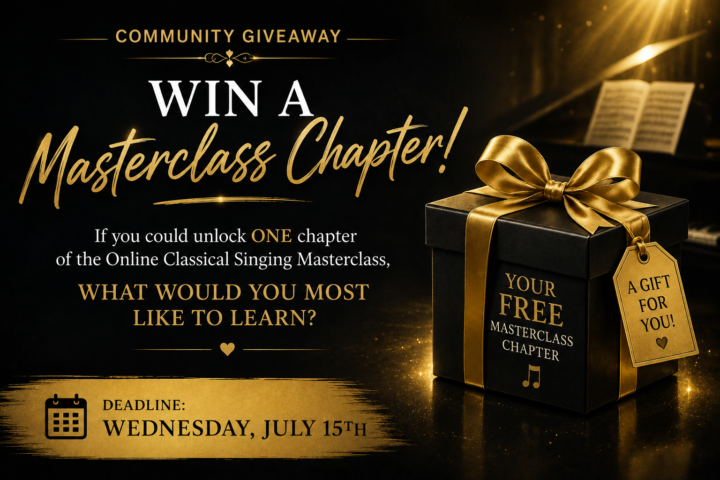
🎁 GIVEAWAY - Win a FREE Masterclass Chapter!
All you have to do is to answer this question: "If you could unlock ONE chapter of the Online Classical Singing Masterclass, what would you most like to learn?" Simply share your answer in the community. 🎁 Every thoughtful answer will receive one Masterclass chapter as a gift to keep forever. ⏰DEADLINE: Wednesday, July 15, at 8:00 PM (Vienna time). After the deadline, I'll personally send each of you the chapter that best matches your answer. 😊
1 like • Jul 9
Passaggio between registers!! Thank you Eva, so generous
0 likes • Jul 18
@Eva Lindqvist dear Eva, sorry for the delay. I sent you my email address by DM on IG.
Jul 3 •
“Do YOU remember when you fell in love with singing? 🌍”
When did you fall in love with singing? 🌍 Was it a performance? A song? A teacher? A childhood memory? Or simply a feeling you could never forget? I would truly love to hear your story ✨ And let’s slowly bring this singers community back to life together again 🌍

2 likes • Jul 3
When I was 5, at the kindegarden. The nun asked me to join a group that were studying some songs to sing for the school director during his next visit. She asked where was that little girl with the soft voice.
0 likes • Jul 4
@Eva Lindqvist Eva, thank you
Jun 27 •
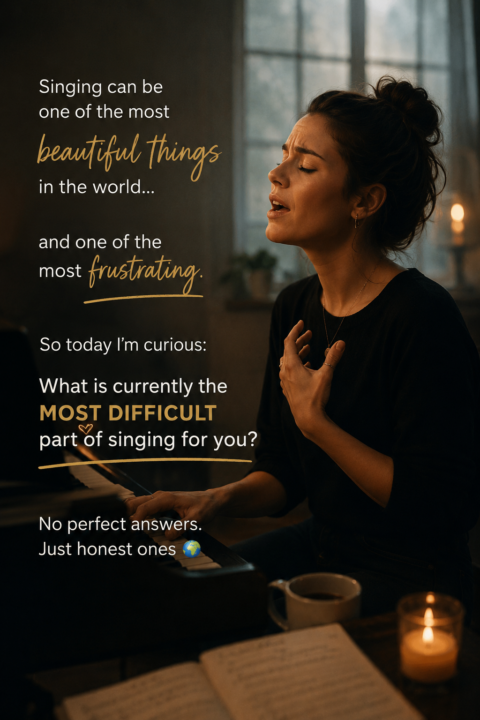
The Most Beautiful Thing - Or The Most Frustrating?
Singing can be one of the most beautiful things in the world… and one of the most frustrating. So today I’m curious: What is currently the MOST difficult part of singing for you? No perfect answers. Just honest ones 🌍
1 like • Jun 28
I am just a chorister. For me it is still a technical issue: the first passage between head and mixed voice, working on it.
1 like • Jun 29
@Eva Lindqvist thank you so much! Your clarifications are precious!
May 21 •
Stop Trying To Sound "IMPRESSIVE" !
🎶 One thing I’ve noticed in many singers: the voice often becomes freer the moment the singer stops trying to sound “impressive.” Very often, freedom begins with simplicity, honesty and coordination - not force. In this post I share a video of my student Lidia singing PIE JESU with real simplicity, honesty and natural coordination. Just connected, free singing and trust in the voice. Lidia is also part of my Online Classical Singing Masterclass, where you can follow her COMPLETE vocal journey over three years AND build your own voice step by step together with us. Lidia is also a member of this community. So..feel free to ask her everything you’d like to know about her vocal journey!!!

0 likes • May 30
@Eva Lindqvist thank you for your explanation!
0 likes • Jun 2
@Philip Owen I am new and I am just a chorister
1-7 of 7
@luisella-sisto-9169
Born in 1958, Turin Italy. Amateur singer, both classic (polyphonic chorister) and modern
Active 13d ago
Joined Mar 26, 2026
Powered by