Activity
Mon
Wed
Fri
Sun
Nov
Dec
Jan
Feb
Mar
Apr
May
Jun
Jul
Aug
Sep
Oct
What is this?
Less
More
whwido /we-do/strength/muscle
38
5.0
Free
Common Sense Carnivore
396
5.0
$6/m
31 contributions to whwido /we-do/strength/muscle

Apr 6 •
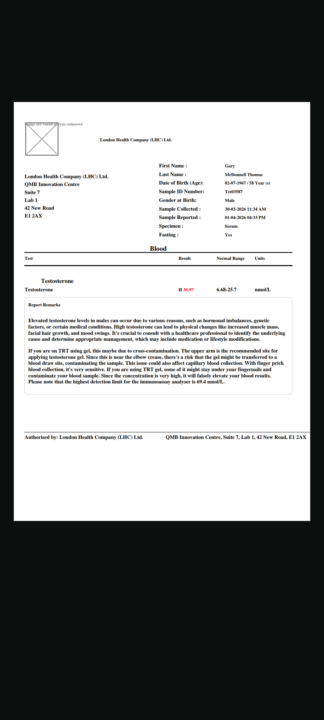
Am I on trt ?
Barely lol Ok so here's the result of the blood test to check testosterone levels. It's about double my natural levels, so I'll take it. But only a third of the levels I got from an identical dose in 2018 so there's definitely malarkey involved with the recently sourced product. However , it's adequate if not good value so I'll proceed to use it. Hopefully the market improves before I need to replace what I have. Hopefully I'll benefit in mood improvement and better body composition going forward
2 likes • 4d
How much would it cost to get an official TRT with the private sector in UK?
1 like • 4d
@Gary Le Rosbifs LOL, so expensive, they want men to be like sheep before they die.......

16d •
HGH and additional 'supplements' ;)
Hi all, im new to the group, but so far loving all the information! Not sure if its allowed or not, but whats people's thoughts regarding use (not abuse!) of steroids/hgh? Also im very interested in people's experience of various peptides, as the space seems to be exploding at the moment
5 likes • 15d
Retatrutide is supposed to the king of all weight loss gear. The results so far according to users is very strong and promising. Ofc, amphetamine, DNP will work wonders. Being a an drug addict is not the best solution. DNP will melt your fat, but it may kill you as well! 😀 TRT gear should be available in the pharmacy to be bought without any GP action......
4 likes • 15d
If I had more money, I would use GH and T with low dosage.
21d •
Reta Update week2
So taking last week as my starting week (Monday) i started off at a small dose of 0.6mg - this week i went up to 1mg and this is where ill be staying for a few weeks - day one - my head knew i had to eat, but i didnt feel like anything so its kinda taking that enjoyment out of it - im normally focused on whats for tea or whats for dinner and looking forward to a big feed at some point in the day - instead i had 3 basic meals to see if i could handle not eating anymore after - 250g of lean mince and 3 boiled eggs for the first meal, once this was eaten i had no interest in eating anymore food and was satisfied that the food i had was good enough - Next meal was the same, the 3rd meal i needed to add some fat as on chekcing my total energy pills for the day was well below what i should be eating - so to bump up my energy pills i added tallow and some cheese - to my last meal, this would also help fuel my next days running, woke up this morning and felt spot on - so went on a good trail run just under 10 miles up and down hills and stuff - was a bit brutal on the hills but thats to be expected, who likes hills ? anyway i had loads in the tank to give it a little push on the last few K - recovery from this - i got to the car and had a bottle of water with electrolytes, felt spot on - i felt empty but not hungry - i then had to go get some bloods done for my cholesterol - done these came back but i wasnt overly hungry, but it was already prepped - i decided to have it and scoffed it with salt and water as well - next meal will be the same mince and eggs - and important is my last meal - again added extra fat to it again to feul tomorrow morning activitys in the gym - so yesterday and today have been pretty good and ive felt different - i also seem to be getting more REM and more deep sleep - time will tell on that thou - so overall the 2nd week so far is sound - finally something that helps me with food noise - its not nice having to deal with food issues as i just want to be kinda normal - so for me its helping - but its still early days - i will continue to update you all and bore the life out of you
4 likes • 21d
Nice report, Sir. Interesting to read what this almost magical reta can do to you!
24d •
Mr 'oh?' llmpia?
In a crazy turn of events this year's freaks are in condition https://www.facebook.com/share/v/19Ubes6BbV/ Funny how people used to think Gaspari wasn't aesthetic but he's frank Zane compared to nick walker lol
3 likes • 23d
Damn, they don't good at all. I am not jelly about their looks. I would rather choose to be like 80 kg and 10% fat than those freaks. Do they have invisible melons at their armpits?
3 likes • 22d
[attachment]
25d •
Post 5 · Eating more fat does not make you lose more fat😮
This is the most repeated claim in low-carb and carnivore spaces, and it needs to be taken apart carefully, because half of it is true. Researchers added 50 g of fat to a standard breakfast. They measured the next 6 hours, then the next 18. Fat oxidation: no increase. Energy expenditure: no increase. The extra fat: stored. It made no difference whether the subject was aerobically fit. (Bennett et al., 1992, American Journal of Clinical Nutrition; R§26) This wasn't a one-off. Three years earlier, a respiration-chamber study added 106 g of fat per day. Twenty-four-hour energy expenditure: unchanged. Fat oxidation: unchanged. Energy balance tracked fat balance at r = 0.96, and didn't track carbohydrate balance at all. (Schutz et al., 1989, same journal; R§26) Two independent experiments, different labs, three years apart, same answer. At maintenance, eating fat does not raise the oxidation of your own fat. No deficit was asking for it. Now the half that's true. A high-fat, low-carbohydrate diet does raise the rate at which your body can oxidise fat. Within days. In a 33-study analysis of athletes, all 30 that measured it found the rate up by 28% to 200%. (R§29) And one crossover showed it's the fat doing it, not the missing carbohydrate. So the machinery retools fast. What doesn't change is how much body fat you lose at the same energy. That's set by the deficit, and by fat eaten minus fat oxidised. In a metabolic ward, an 80%-fat diet at the same energy slowed body-fat loss. (Hall et al., 2016; R§27) Rate up, balance unchanged. Two different quantities, and the argument only works if you keep them apart. There's also a mechanism working directly against you here, and almost nobody mentions it. Ketones suppress lipolysis through a receptor called HCA2. Tested head-to-head, ketone infusion abrogates growth-hormone-driven lipolysis. When ketones are high, the brake overrides the accelerator. Ketones made from your own fat throttle appropriately; you drew down the store to make them.
2 likes • 24d
@Gary Le Rosbifs Will a bottle of vodka break my fast? 😀
1-10 of 31
Online now
Joined Aug 16, 2026
Helsinki, Finland
Powered by