
Write something
Pinned
🔥
8h •
Describe Before You Name
When something changes in the body, we often move very quickly from noticing it to naming it. "My throat is sore." "My stomach is upset." "I have a headache." Those descriptions are useful, but they can hide another layer of information. Before deciding what something is, we can first ask, what am I actually noticing? Is the area warmer or cooler than usual? Does it feel dry or moist? Tight or relaxed? Heavy or light? Is something moving freely, or does it feel congested or stuck? These observations do not diagnose a condition. They simply give us a more detailed description of what we are experiencing. That distinction becomes important when we begin studying traditional herbal patterns. Words such as hot, cold, dry, damp, tense, weak, or stagnant are ways herbal traditions have organized observations. They should not be treated as medical diagnoses, and noticing one quality does not automatically tell us which herb to use. For now, we do not need to choose an herb at all. We are practicing something that comes first, describe before you interpret. Think about the difference between saying, "My skin is irritated." and saying, "The area feels hot, dry, tight, and itchy." The second description still does not tell us the cause, but it gives us more information about what is actually being observed. That is the skill I want us to develop before we begin matching herbs to patterns. This week, choose an ordinary sensation you notice. Before naming what you think it is, see how many simple qualities you can use to describe it. What changed when you separated what you observed from what you thought it meant? When you notice something different in your body, which happens first for you?
Poll
3 members have voted
5
0
Pinned
🔥
1d •
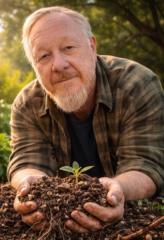
Roots Respond to the Soil They Find
A plant's root system is not a fixed blueprint. Roots grow within the conditions they encounter. A compacted layer may restrict where roots can penetrate. Poorly aerated or waterlogged soil can limit root growth, while available water and nutrients can influence where roots branch and explore. This ability to change root growth in response to conditions is called root plasticity. That means two plants of the same species may not occupy the soil in exactly the same way if they are growing under different conditions. So when we uncover a root system, we are seeing more than a characteristic of that plant. We are also seeing part of the plant's response to the soil it has been growing in. The useful question is not only, "What kind of roots does this plant have?" It is also, "What conditions helped create the root system I am seeing?" Two plants of the same species are dug from different parts of a garden. One has roots extending deeply through the soil. The other's roots spread mostly above a dense compacted layer. What does this observation best demonstrate?
Poll
2 members have voted
Pinned
🔥
3d •
Before Biodynamics Had a Name
In June 1924, a group of farmers gathered on an estate at Koberwitz, in what was then Germany and is now Poland. They had come to hear Rudolf Steiner speak about agriculture. Steiner was not primarily known as a farmer. He was a philosopher, writer, lecturer, and the founder of anthroposophy. His work had already moved into education, medicine, the arts, and other parts of human life. Agriculture came near the end of his life. From June 7 through June 16, 1924, Steiner gave eight lectures that later became known as the Agriculture Course. Those lectures eventually helped give rise to what we now call biodynamic agriculture. Before we get into what he actually taught, I think it is worth understanding the question underneath the course. Steiner was looking at a farm as more than a collection of separate problems. Soil, plants, animals, manure, food, weather, landscape, and the people caring for the land were relationships within a larger whole. That way of looking at a farm is one reason I think this is worth exploring through Roots Through Time. It does not mean that everything Steiner proposed should be accepted as scientific fact. Some of his agricultural ideas grew from observation. Others came directly from his anthroposophical worldview, including ideas about spiritual and cosmic influences that modern science does not establish in the same way. We can keep those things separate without dismissing the historical value of the questions he was asking. Over the next several Roots Through Time posts, I would like to work through these lectures slowly. We can look at what Steiner actually said, what farmers and biodynamic practitioners later did with those ideas, and what modern soil biology, ecology, agronomy, and observation can tell us today. More than a century later, one of the questions behind that gathering at Koberwitz is still useful. What changes when we stop looking at the pieces of a farm or garden separately and begin looking at the relationships among them?
🔥
10h •
How To Pay For Living Your Life Without "Working"?
Service can be such a misunderstood word for people who want to do work that matters. Most of them are not out there trying to serve you. They are doing what they love, doing it well, and you happen to benefit. That is what I call service through the act of living. When you live the life you actually want to live, you cannot help but create value for other people. It spills over. And that value is what ends up paying for the life. I lived and traveled for nearly ten years in a van that I turned into a livable space. I called it my Mobile Domicile. People always asked: "How can you afford to travel all the time?" I gave away balloon animals. I did not sell them. I gave them away, and people gave away money, on their own. And just to be transparent, I was not on a mission. I was not out there doing "service." I was living the life I wanted, and the living of it happened to put a smile on somebody's face. Over the years that voluntary income added up to more than half a million dollars. Most of us were taught it the other way around. You serve somebody else's purpose, and you get paid. Then, if you plan it well, or get lucky, you get to live someday. What if you flip the script and start by looking at what you already do just by being you, that other people value? It is probably closer than you think! That's how you create a Self-Sustaining Life.
2
0
🔥
4d •
Hey Wanderer
I want to welcome Casey from Hey Wanderer to the Oasis Builders family. I met Casey during the Master Gardener training I completed this Spring. Casey and Savannah are a few years into building an off-grid homestead from the ground up, learning firsthand about land, water, shelter, gardens, animals, infrastructure, and all the decisions that come with trying to build a working system. That kind of lived experience brings a wealth of information to our community. I love watching another piece of property develop from the beginning to a new Oasis. We talk a lot about observing before we act at Oasis Builders. A new property gives us the chance to look at the land, water movement, soil, existing plants, sun, wind, access, and family needs before deciding what belongs where. This is where a piece of land begins becoming a connected system rather than simply a collection of projects. If you get a chance, stop over at Hey Wanderer on YouTube and see what Casey and Savannah have been up to. Hit subscribe while you are there. I think there could be some good conversations between our communities as their next adventures unfold. https://www.youtube.com/@HEYWANDERER Casey, glad to have you here. I am looking forward to seeing what you are considering for your property next. And as aways a question, what is the first thing you would want to observe before making plans for a new piece of property?
1-30 of 578
powered by
skool.com/oasis-builders-8012
Understand living systems through permaculture principles, regenerative farming, safe medicinal herb use, and calm practical family resilience.
Suggested communities
Powered by