
Write something
Pinned

Mar 12 •
🚨 The #1 Question I Get: "What's the Best Ultrasound Device to Buy?" (My Official Answer + Regional Guide)
Welcome to the group! I know the first few modules are in the Classroom: Skool.com/vagus/classroom available to read right now - but I always see the same question pop up immediately: "What device should I buy?" Instead of *I guess* hoping you will make use of the Classroom which already has the answer, or hoping you would use the Search feature at the top of the site, I wanted to put the answer front and center. This post will be pinned at the top, so you can reference it anytime. The goal is to get you started with the right tool for your region. Let's break it down: USA: If you are in the USA: The US-1000 is your go-to. It’s affordable, incredibly effective, and the perfect entry point for Vagus Nerve Stimulation. For around $54 USD, it’s one of the most accessible biohacks you can invest in. The benefits—from reduced inflammation and deeper sleep to a calmer nervous system—are tremendous for the price. - 👉 Click for Module 2: How to Buy an Ultrasound - 👉 Click for Module 3: How to Use & Place Ultrasound 🌍 If you are in Canada: Great news, the US-1000 is also easily available. - Canada Supplier: Link EU: If you are in the EU or UK: The Rules are a Little Different Due to regulations and availability, the US-1000 isn't sold here. You’ll be looking at the US-2000 Pro class of device. Don't let the "Pro" name intimidate you! It simply means these units produce a higher power output and offer more focused stimulation. You don't really have a choice in the matter, but honestly, you're getting a slightly more powerful unit out of the gate.

Pinned
Mar 13 •
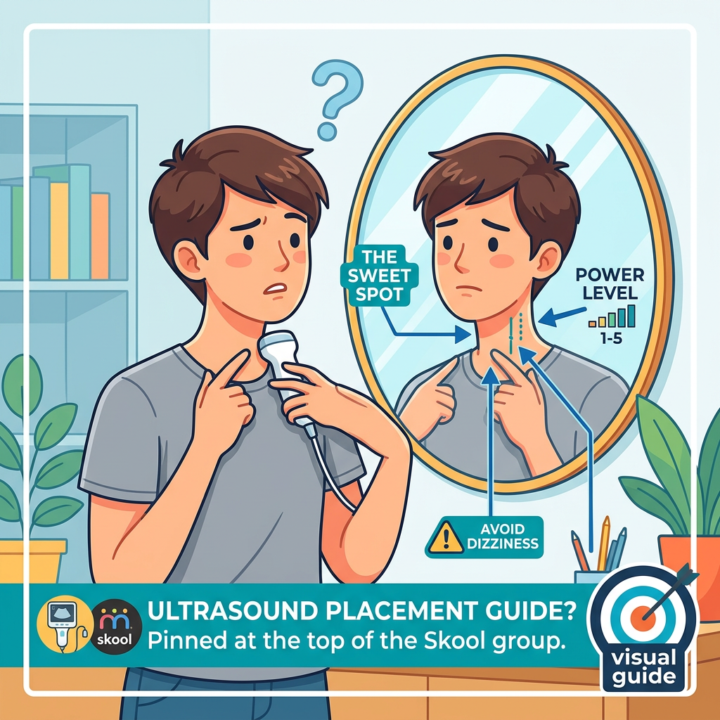
📸 The #2 Question: "Got Any Pictures of How to Use This Thing?" (Yes! Here is the Visual Guide + The Golden Rules)
You got your device (hopefully from the pinned post above! 👆), and now you're staring at it thinking, "Okay... but where does this thing actually go on my neck?" It is the second most common question I get, and the answer is critical. Slapping the ultrasound on the wrong spot is like trying to charge your phone with the wrong cable—it just won't work, and you might get a weird error message (dizziness, tingling, etc.). I have built a whole module dedicated to this, complete with diagrams and a video guide. It covers the exact anatomy, the "mirror trick," and how to avoid overstimulation. 👉 [CLICK HERE FOR MODULE 3: Ultrasound Setup & Neck Placement] The "Cheat Sheet" Before You Click: Since you are here asking for pictures, here is a quick preview of what is waiting for you inside that module so you can get it right the first time: 1. The Setup (Don't Skip This!) - Gel is Boss: Do not turn the device on without it. It is not lotion; it is the conductor. - Warm it Up: Cold gel is a shock to the system. Warm the bottle in your hands first for a spa-like vibe. 2. The "Sweet Spot" Placement - The Location: It is on the left side of your neck (you can do the right side ONLY when you're absolutely sure you can find the left side Vagus Nerve). - The Landmarks: You are aiming for the point between the crease behind your jawline, the bottom of your earlobe, and the big neck muscle (sternocleidomastoid). - The Mirror Trick: Use a mirror to watch the placement. If you feel a tingle or your voice wobbles, you are hitting a nerve—move slightly inward (towards your windpipe). 3. The 5-Minute Goldilocks Rule - Minute 0-1: Level 1 (Gentle introduction) - Minute 2-3: Level 2-3 (Building warmth) - Minute 4-5: Level 4 (The "Ahhh" zone) - Red Flag: Nausea or headache? Stop immediately and sip cold water. Bonus: When to Do It (Module 4 Sneak Peek) Timing matters! Most people love this before bed for deep sleep, but you can also do a low-intensity session in the morning for "alert calmness" without the jitters.
Pinned
Jan '25 •
Welcome to Vagus Skool ! (Start Here) ✊
This is a Free to Join Skool Community! A community designed to help people Stimulate and Repair their Vagus Nerve! Comment Below! - What you know about the Vagus Nerve 🦄 - Your preferred method of Vagus Nerve Stimulation ? (Breath, TENS, Ultrasound, etc?) 👩💼 - A Want or Have Had Experience from Vagus Nerve Land !? (A win, or something you are striving for) And when you comment, like a post, get 5 likes across your comments, and click "Complete" on a few of the modules in the Classroom, you can then unlock the Ultrasound module ! YAY ! So, I hope this can become a great community page, it's very open, and you have access to SO MUCH good information, actionable information, on the Vagus Nerve, and all the ways you can make it happy and healthy ! So from the Vagus Skool to you and yours... WELCOME !


May 6 •
High intensity Right Insular Cortex stimulation
Ive been targeting the Right Insular Cortex ever since I got my US-2000, on MEDIUM. It has been beneficial. Last night despite the warning, I tried it on HIGH intensity for giggles (I know, I know..). I thought I'd share my experience for the sake of science and anyone curious: In short it reminded me of a bad trip. Late at night I placed the device on my head, and within seconds I felt like my heart was racing, and that I was out of breath. I laid down on my bed, and my sense of self was dissolving, sending my brain into panic mode. Similar to the beginning of n drug induced EGO death. My mind was deepfried, struggling to form any coherent thought, while a rush of emotions came on, fear sadness surprise etc. Slept it off, but it was hard. Like trying to sleep on a bad fever. Waking up occasionally throughout the night, with incoherent thoughts calling me to act. Like there was something I needed to do or pay attention to. Conclusions: There was a lot of stuff stored in there. Targeting this area on HIGH triggered an intense rush that overwhelmed me. Completely different from MEDIUM intensity. Is it unsafe at this intensity ?


2d •
New to the Community membership
I'm really GLAD to be invited to this very interesting Community! With my congratulations for the helpful and deep scientific knowledge you diffuse. I will learn a lot. I've found a great help in practicing VNS through breath and, as a biologist, I then studied with interest this significant branch of human physiology and pathophysiology. I will follow the Community with interest.
1
0
1-30 of 483

skool.com/vagus
This group is designed for the discussion of the Vagus Nerve, techniques to stimulate it, and the benefits of doing so.
Leaderboard (30-day)
1

+3
2

+3
3

+3
4

+2
5

+2
Powered by