Activity
Mon
Wed
Fri
Sun
Nov
Dec
Jan
Feb
Mar
Apr
May
Jun
Jul
Aug
Sep
Oct
What is this?
Less
More
Music Money Makers
592
5.0
Free
AMP: The Artist Master Plan
674
Free
Mastering.com Members Club
38.1k
4.7
Free
The Creator CEO Club
247
Free
Future Producer Society
90
Free
37 contributions to Future Producer Society

4d •
Sharing What I’ve Learned 🎓
One thing I’ve realized on this producer journey is that whenever I figure out a workflow or solve a problem that made my own process easier, there’s probably another producer out there trying to figure out the exact same thing. So instead of keeping it to myself, I’ve been trying to document more of what I learn and share it. This tutorial walks through how I turn a simple 4-bar loop into a full song on MPC 3 — building an 8-bar hook, creating different verse sections, adding an intro and outro, and then putting everything together in Song Mode. Hopefully it saves somebody else some of the trial and error I went through figuring it out. If you’re working with the MPC and you’ve been getting stuck making loops instead of full arrangements, check it out. And if you already have your own way of doing it, drop your method in the comments too. I’m always interested in seeing how other producers approach the same problem. https://youtu.be/W1jNSxHBFMo

1 like • 4d
@Rick Chestnutt Absolutely Incredible direction . LOVE how you describe EVERY move that you make and mention EVERY part of the screen that you are touching and for what reason . OUTSTANDING JOB !!!

Aug 9 •
Studio Equipment
Any recommendations on the best places to sell older studio gear? I’m looking to upgrade a few pieces of my setup and would love to hear what platforms you’ve had the best luck with.
1 like • Aug 9
@Rick Chestnutt Hey My Brotha , yes indeed that was what friends told me years ago. Hold on to your gear , it will always have some use and definitely comes back around at some point . Thanks my Brotha , appreciate it
Jul 31 •
Every Beat Is an Asset
One of the biggest mindset shifts I've had over the past year is this: Stop thinking of every beat as content. Start thinking of every beat as an asset. Content is made to get views. Assets are built to create value over time. When I first started making beats, I was focused on finishing the music. Once the export was done, I felt like the job was over. The more I've learned about this business, the more I've realized that's actually when the work begins. An asset has to be managed. That means making sure: - You actually own what you created. - Your split sheets are completed. - Your metadata is accurate. - Your publishing is registered. - Your PRO information is current. - Your contracts are organized. - Your royalty accounts are set up. - Your payment information is ready before the money starts flowing. Think about it this way... If someone owned a rental property, they wouldn't buy the house and then forget about the deed, insurance, taxes, or maintenance. They protect it because it's expected to generate income. Music deserves the same mindset. Every beat you finish has the potential to become something bigger: - A placement. - A sync license. - A sample. - A remix. - A commercial. - A TV cue. - An artist record. - Or income you haven't even imagined yet. But potential only matters if you've done the work to protect it. I'm realizing that producers don't just build catalogs. We build portfolios of assets. And assets need documentation, administration, protection, and periodic review—not just great drums and melodies. What's one thing you've started doing to treat your music more like an asset than just another upload?

1 like • Jul 31
@Kazz Milz Yess sir
1 like • Jul 31
@Rick Chestnutt Awesome Info

Jul 20 •
RIP: Atlanta Rapper Alley Boy Reportedly Dead After Battle With Kidney Failure
Today is a difficult one. Like many in Atlanta's music community, I'm saddened to hear about the passing of Alley Boy. When we first relocated from New York to Atlanta, Alley Boy was one of the very first artists we built with. We created records together during an important period in both of our journeys, and I got to witness firsthand why he meant so much to this city. Not every artist changes the entire industry. Some change a city. Some become the soundtrack to neighborhoods, inspire the next generation, and leave a cultural imprint that can't be measured by charts or streams alone. Alley Boy was one of those artists. As producers, we often focus on placements, royalties, and building careers. But moments like this remind us that behind every record is a person, a family, and a legacy that extends far beyond the music. If you've had the privilege of working with artists throughout your career, cherish those relationships. Document the stories. Save the photos. Keep the sessions. One day those memories become part of music history. We're grateful we had the opportunity to create alongside Alley Boy, and we'll always remember the impact he had on Atlanta and everyone who believed in his vision. Rest easy, brother. 💫 RIP Alley Boy 💫

0 likes • Jul 20
@Collin Jugrnaut D Sincere Condolences my Brother. Never easy dealing with the loss of someone close to you or someone you’ve spent a special period of time with. According to Gods plan , we will see our lost loved ones again . John 11:25 , John 5:28,29
Jul 12 •
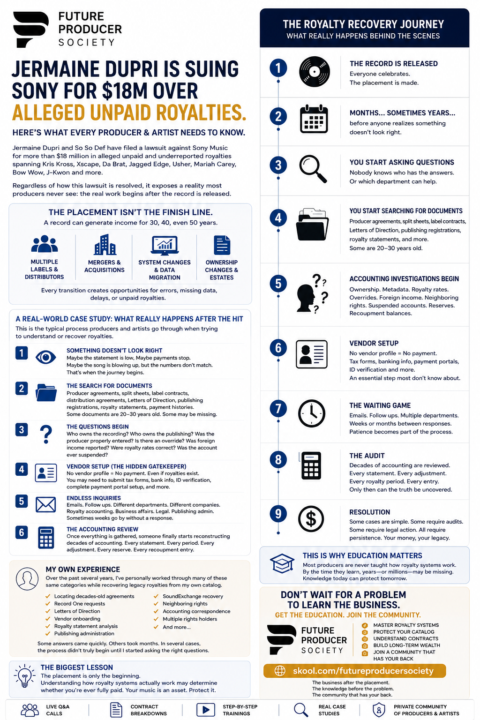
Jermaine Dupri's $18 Million Royalty Lawsuit: What Every Producer & Artist Needs to Know
When most people read the headlines, they see one story: "Jermaine Dupri and So So Def sue Sony Music for more than $18 million in alleged unpaid royalties." The conversation immediately becomes about who's right, who's wrong, and whether the lawsuit will succeed. But if you've spent enough time in the music business, you see something very different. You see a reminder that the biggest challenge often begins after the hit record is made. Regardless of how this lawsuit is ultimately resolved, it highlights something every producer, songwriter, artist, and independent label should understand: Getting paid isn't a single event. It's an ongoing business process that can last decades. Most Producers Think The Process Looks Like This Create the beat. Get the placement. The record is released. Royalties arrive. The End. Unfortunately, that isn't how the music business works. In reality, a successful record can generate income for 30, 40, or even 50 years. During that time, the rights attached to that recording may pass through multiple labels, distributors, publishers, royalty systems, accounting departments, mergers, software migrations, estates, business managers, and ownership changes. Every one of those transitions creates opportunities for administrative errors, missing information, delayed payments, or unresolved questions. The Work Usually Starts When Something Doesn't Add Up Many producers don't begin investigating their royalty accounts until they notice something doesn't seem right. Maybe a statement looks unusually small. Maybe royalties stop appearing. Maybe a song becomes more successful than expected, but the accounting doesn't reflect that success. Maybe another producer mentions they're receiving payments you never knew existed. That's when the real work begins. Not making music. Finding answers. The Search For Information One of the biggest misconceptions about royalty recovery is that someone simply "checks the numbers." In reality, the process often starts with locating documents that may not have been seen in years.
1 like • Jul 12
@Collin Jugrnaut D Awesome info . Thanks Jug
1-10 of 37
@richard-harmon-5894
Singer , Songwriter , Producer
www.stonecoldharmony.com
Active 3h ago
Joined Jan 19, 2026
Powered by